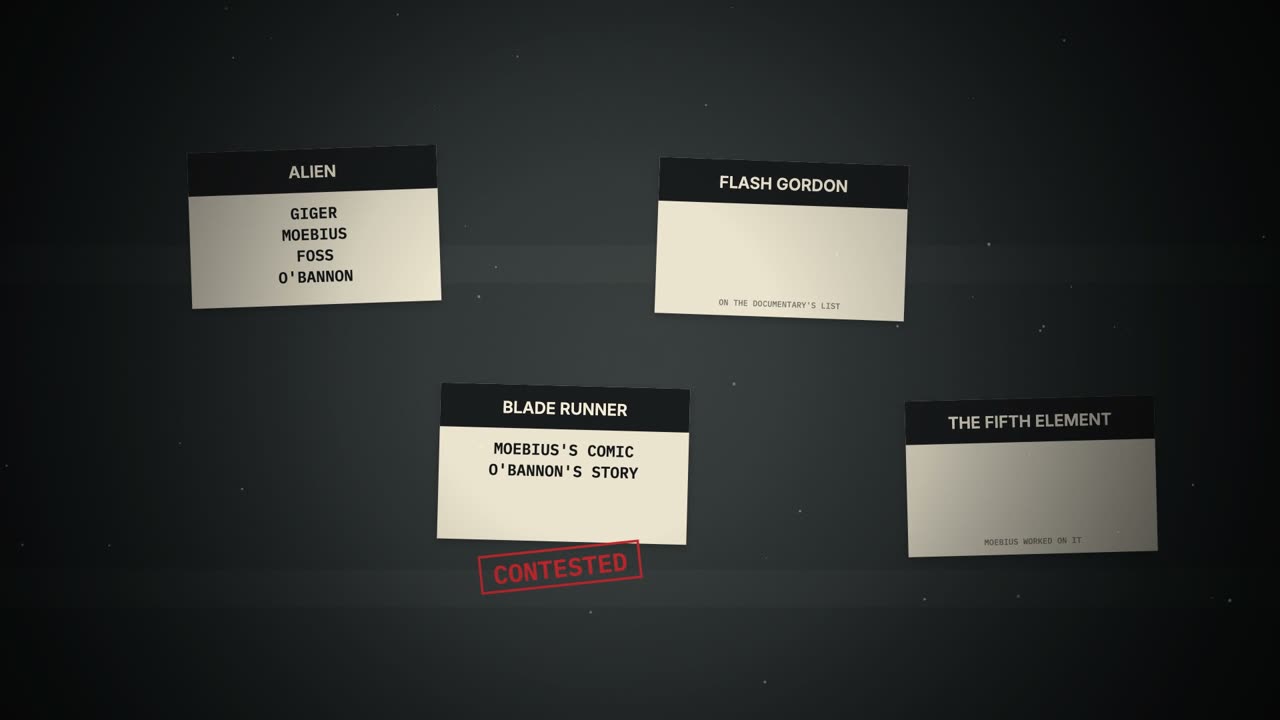
Why Is Hollywood in California? The Edison Escape Legend vs the Record
Why is Hollywood in California? Not a dash to Mexico from Edison's men. That story first turns up in a 1931 book. Here's what the court record says.

Why is Hollywood in California? The trade papers of the time give the plain answer: the climate and the scenery. A Los Angeles paper in 1910 wrote that "the background for any kind or style of picture may be found here" [7]. In 1911 the owner of Nestor, usually called the first studio in Hollywood itself, wrote to a trade paper praising "the climate and scenery" [8][9]. And Fort Lee, New Jersey, the East's film town, lost out, in its historian's view, to cheaper land, cheaper labour and work that didn't stop for winter [15][16]. The famous answer, that filmmakers fled Edison's patent Trust and settled near the Mexican border so they could dash across it, first turns up, as far as we can find, in a history book in 1931 [10]. Hollywood was about 140 miles from the border, some five hours away [17][18]. And the Trust itself wasn't beaten on the road. It was beaten on paper, in court [2][3][4][5].
The legend: Edison's men, smashed cameras and a dash to Mexico
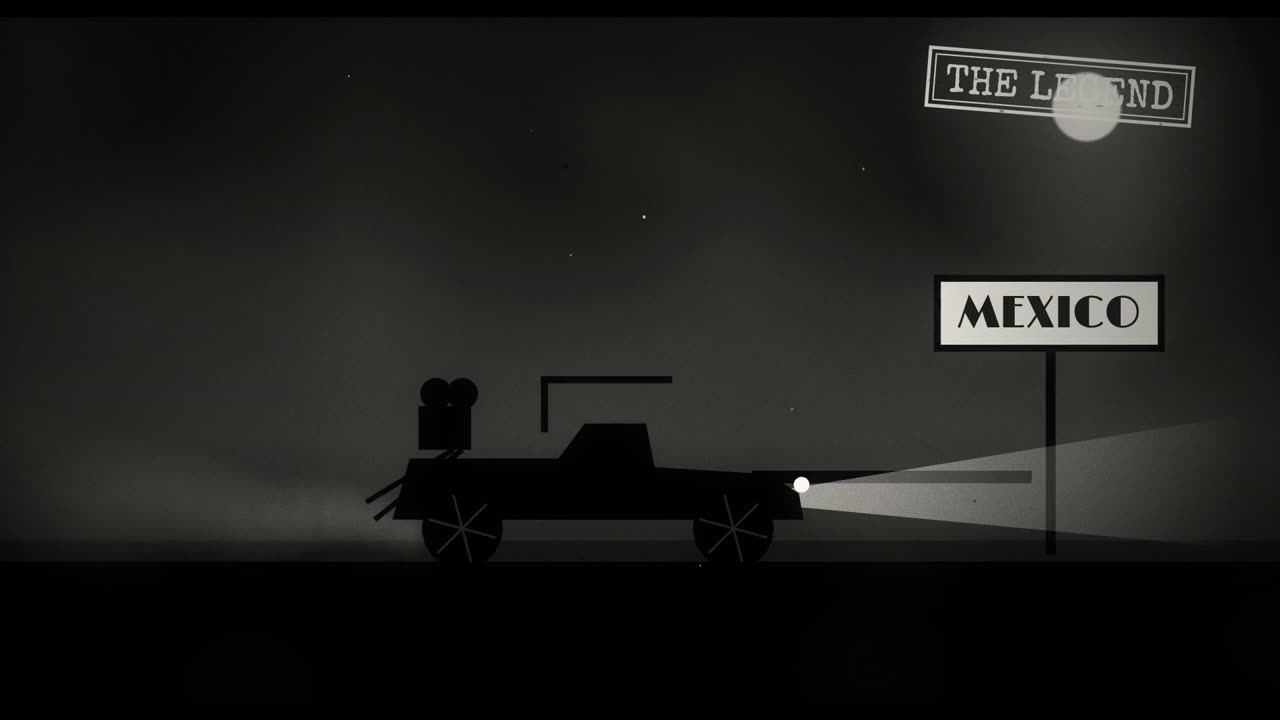
You've probably heard some version of it. Edison's men chased the independent filmmakers out of New York. They smashed their cameras. So the filmmakers ran to Los Angeles, close to the Mexican border. A lookout watched the road. And when the law showed up, they grabbed the cameras and dashed across the border into Mexico.
It's a great story. The problem is where it comes from.
Where the Mexico story first appears: a 1931 book
The getaway, as far as we can find, first appears in Benjamin B. Hampton's A History of the Movies, published in 1931 [10]. Hampton writes that Los Angeles had one advantage that outweighed all others for the outlaws fleeing subpoena servers and camera smashers: it was close to the Mexican border. A signal from a lookout, he writes, would send the troupers to hustle the cameras into a motor car and dash across the border, where Uncle Sam's marshals had no power [10].
The biggest account written before that, Terry Ramsaye's A Million and One Nights from 1926, has no border escape at all [11]. Its passages about Mexico are about a prize fight and the Latham family, not about fleeing filmmakers [11].
We searched the archive.org full text of trade papers, newspapers and books from 1908 to 1930 for anything earlier. Nothing turned up [10][11].
After Hampton, the story spreads: Lewis Jacobs repeats it in 1939 [12], Leslie Wood in 1947 [13]. Each retells it. None is earlier than 1931.
So where did Hollywood really come from?
Why is Hollywood in California, then?
Before Hollywood, there was Fort Lee
Start in the East. Before Hollywood there was Fort Lee, New Jersey, a ferry ride from Manhattan, where film companies were shooting from 1907 and building studios soon after [15]. Richard Koszarski, Fort Lee's historian, puts its appeal simply: "All we have to do is get on the ferry. We can go here, and we can plant the camera and film in any direction." [16]
So why didn't Fort Lee stay the film capital? Koszarski names cheaper land, cheaper labour and the winter [15][16]. Eastern crews had to stop, or go south [15]. And in the winter of 1918, wartime coal rationing forced most of Fort Lee's studios to close [15].
He sees the Trust as a smaller part of the story; his booklet on the move doesn't mention it at all [15].
The first film companies in Los Angeles were mostly licensees
Now go west. Early in 1910, a Los Angeles paper, reprinted in Moving Picture World, counted three film companies in and around the city: Selig, the New York Motion Picture Company and Biograph [7]. Two of those three, Selig and Biograph, were among the nine companies licensed by Edison's patent Trust [1] (more on the Trust below).
And the paper's reason was the setting: "The background for any kind or style of picture may be found here." Snow on Mount Lowe, the seashore, orange groves within ten miles of the city [7]. It doesn't mention patents at all [7].
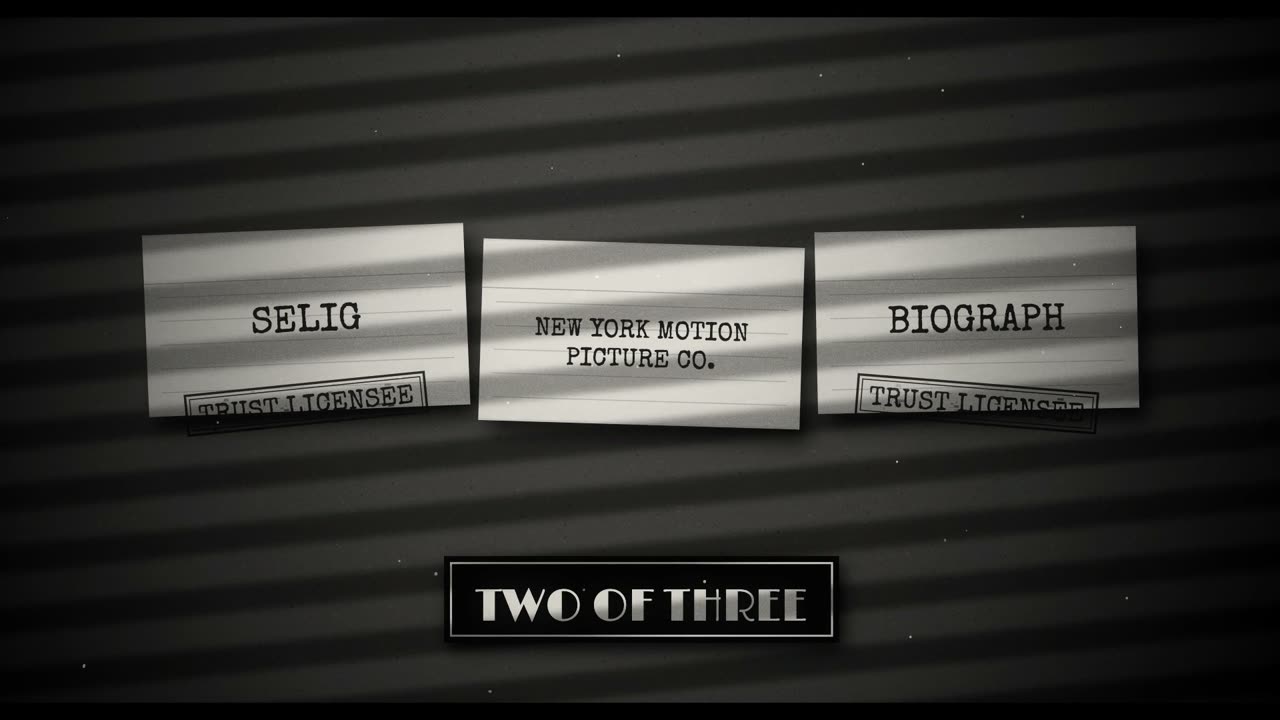
There is one company whose history fits the legend: Selig. In autumn 1907 an injunction on an Edison camera patent was sought against it in Chicago, and in January 1908 Selig signed an Edison licence [1]. Even so, nothing in the record says that suit sent Selig west.
Nestor, the first studio in Hollywood itself
Then there's Nestor. In the autumn of 1911, Nestor, an independent, set up at the corner of Sunset and Gower [8][9]. It's usually called the first studio in Hollywood itself. A 1911 trade paper called its owner, David Horsley, "the pioneer of the Independents" [9]. Nestor was an independent, so the pressure story could fit it; the papers say otherwise.
Listen to what Horsley wrote. Moving Picture World reported a letter from him "praising the climate and scenery and stating that he has decided to permanently locate there" [8]. None of the 1911 and 1912 Nestor items we read mentions the Trust or the law [8][9].
That same winter, the trade press listed eight film companies in Los Angeles [8]. Five held Trust licences [1][8].
Distance didn't buy much cover anyway. The historian Eileen Bowser writes, citing Balshofer's own account, that Patents Company spies found the New York Motion Picture Company easily in California, a short time after it got there [14]. That's a report, not a court record.
How far was Hollywood from the Mexican border?
Which leaves the border. From Sunset and Gower to today's San Ysidro crossing is about 140 miles by road [18].
In 1912, an express train took about four hours just to reach San Diego [18]. Then came the last fifteen miles or so south to Tia Juana [18]. By car, the record run from Los Angeles to San Diego in 1911 took four hours and ten minutes [18].
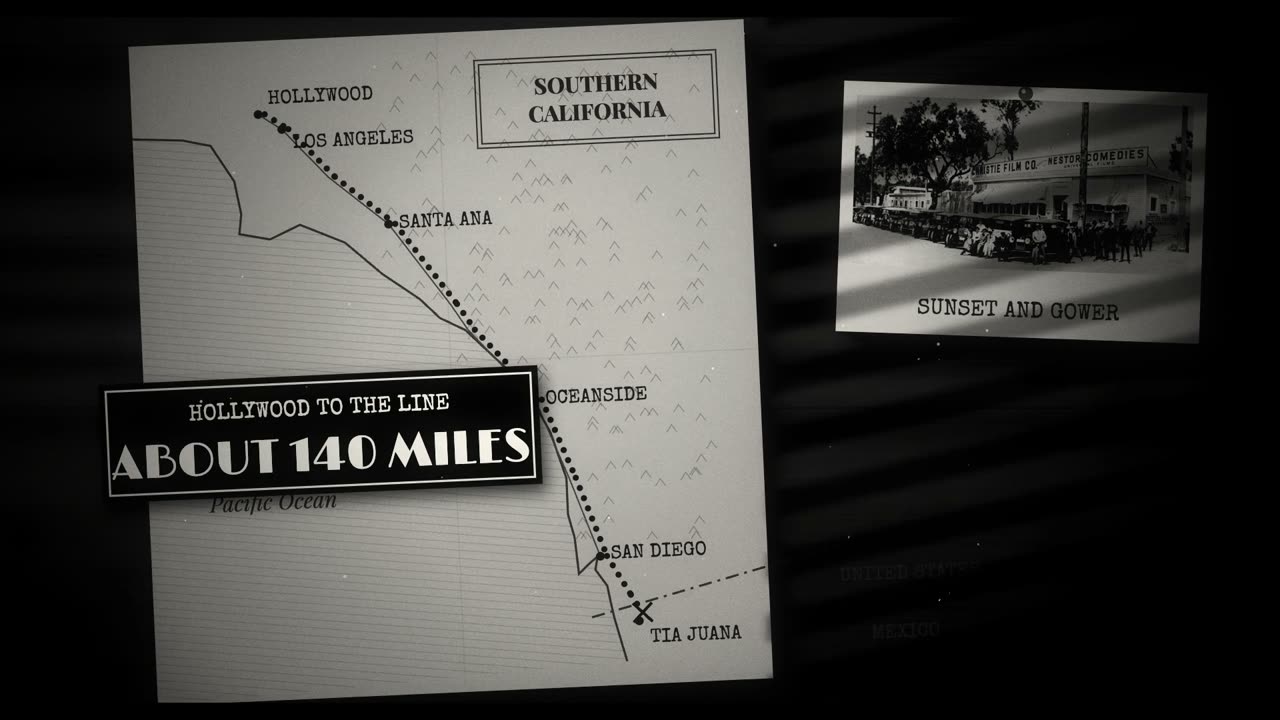
Add it up, and it's about five hours each way [18], before you even get from Hollywood to the station downtown. A dash, it isn't.
The historian Robert Sklar made the same point, as quoted by PBS SoCal's Lost LA: Mexico was a five-hour drive from Los Angeles in those days, the trip would have cost at least a day's production, and the legal papers could be served at the business offices in New York anyway [17].
None of this means the Trust was harmless. Its pressure on the independents was real, and it's all in writing [1].
What was the Edison Trust?
Officially, it was the Motion Picture Patents Company, incorporated in New Jersey on 9 September 1908 [6]. Its incorporators were the Edison Manufacturing Company and the American Mutoscope & Biograph Company [3][6]. They pooled their patents: sixteen in all, of which six mattered, one each for films, cameras and a part called the Latham loop, and three for projectors [3].
Then the Trust licensed nine film makers and importers, and only nine: Biograph, Edison, Essanay, Kalem, George Kleine, Lubin, Pathé, Selig and Vitagraph [1]. Its circular of 22 January 1909 said films from anyone else were "infringements of our patents", and that any exchange or theatre handling them was liable to suit [1].
Theatres that wanted licensed films paid about two dollars a week for a licence [1]. And from January 1909, Eastman Kodak agreed not to knowingly sell its film to anyone but the Trust's licensees [1].
When a theatre showed the wrong films, the Trust sued: replevin suits, to seize the film itself. One bulletin in March 1909 listed thirteen theatres whose film had been taken [1]. Licences were cancelled too [1].
How many suits in all? The Trust's vice-president, H. N. Marvin, was asked under oath. "Many such suits," he said. "I have no idea of the number." [1]
That's the record: lawsuits, seized film and cancelled licences, all in writing [1]. Notice who isn't in it. The Trust was formed from the patents of Edison's company and Biograph's, but nothing in the record we read shows Edison himself doing anything in it.
William Fox says no
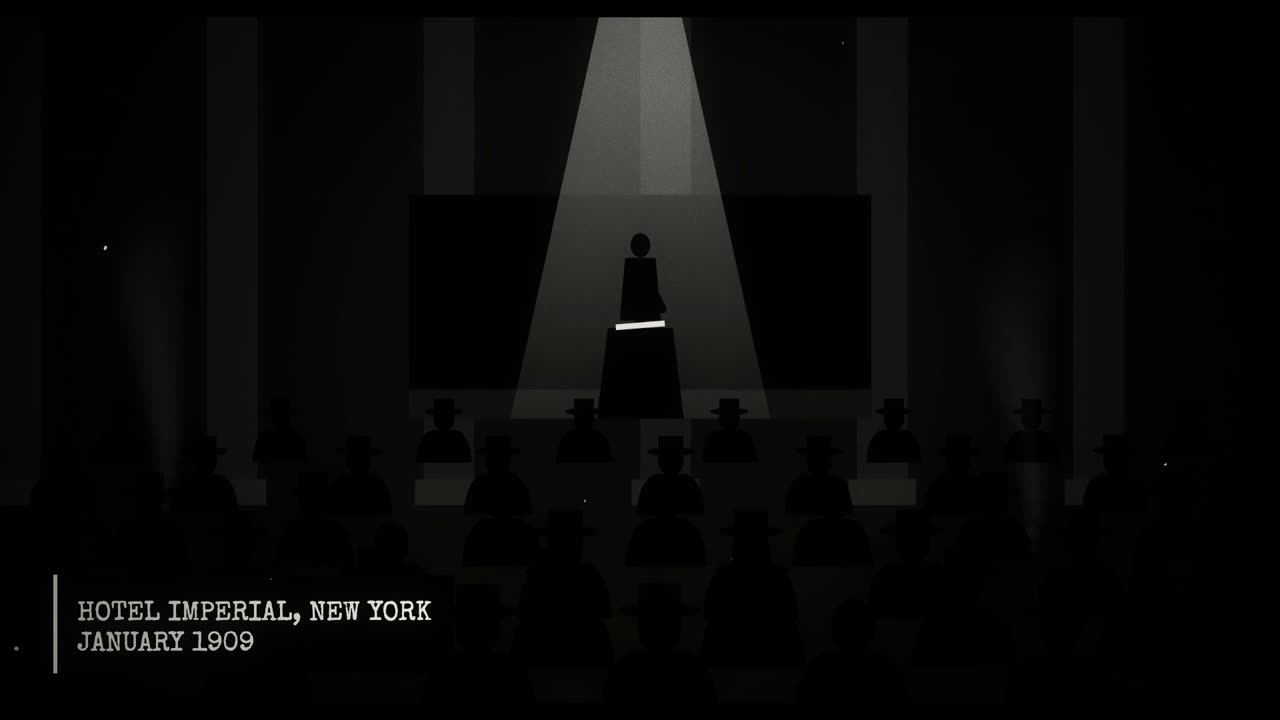
The clearest look inside comes from William Fox, who ran a New York rental exchange, a company that rented films to theatres. In January 1909, about sixty exchanges met at the Hotel Imperial in New York to hear the Trust's new licence read out [1]. Fox later testified that he stood up and protested: exchanges had bought their films outright, and now the Trust would only lease them [1]. A committee asked for changes; it came back, he said, "without the crossing of a 't' or the dotting of an 'i'" [1].
In April 1910 the nine licensed film makers set up their own distributor, the General Film Company, and it bought up licensed exchanges [1]. Of 116, a judge later found "one solitary survivor" [3]. Fox was the holdout: he named $150,000 as the least he would take, and didn't sell [1]. On 14 November 1911 a letter came from the Trust, signed by Marvin, ending his licence on 4 December [1]. His company went to court; the papers cited here don't record the outcome. Apart from the letter itself, all of this is Fox's own sworn account.
Did Edison's men really smash cameras?
The smashed cameras come from books. Ramsaye, in 1926, writes that cameras "vanished from under the noses of the guards", and tells of a riot at a New York Motion Picture Company shoot where some of the extras turned out to be gunmen [11]. Hampton, in 1931, adds "detectives, spies, and plug-uglies" sent to smash unlicensed cameras [10]. Neither names a source. And in the volumes of the government's trial record we searched, no witness and no exhibit describes a smashed camera.
Even the detectives are a question. The government's lawyer asked the Trust's secretary, Pelzer, whether it kept a large force of detectives. "If there are any such," he said, "I never heard of them." [1] Marvin, asked the same thing, said no [1]. That's their sworn answer, not proof either way, so the detectives stay disputed.
How the Trust lost, on paper
By the time Fox's letter arrived, the Trust's grip was already slipping.
The film supply, February 1911. You'll often read that a court forced Kodak to sell to the independents. It didn't. On 14 February 1911, nine months before Fox's letter, the Trust, Edison's company and Kodak rewrote their contract. Now Kodak could sell film to companies without a licence, at a slightly higher price [1]. A contract change, not a court order.
The camera ruling, 1912. The Trust had sued an independent company, IMP, on the Latham patent [2]. IMP was using its machine as a camera. Judge Learned Hand held that "the patent does not cover a camera" [1], and wrote: "I mean to decide nothing else." [1] That's narrower than the legend makes it. Hand didn't strike the patent down. In August 1912 the appeals court agreed with him, two judges to one [2].
The antitrust case, 1912 to 1915. That same month, August 1912, the government sued the Trust under the Sherman antitrust law [6]. On 1 October 1915 Judge Dickinson found the combination "a conspiracy in restraint of trade" [3]. The patents, he wrote, weren't the real purpose [3]. Control of the patents was made a feature of the scheme, in the hope that this would render the scheme, otherwise illegal, "not open to the condemnation of the law" [3].
To be fair, he also listed better motives, including, "as they frankly admit, to make money for themselves." [3] Good motives, he held, are no defence [3]. Note the word: he found. He didn't dissolve anything.
The Supreme Court, 1917. On 9 April 1917 the Court held that a patent owner couldn't use a notice on a projector it sold to dictate which films the machine showed [4].
The end, 1918. The Trust appealed Dickinson's ruling. On 3 June 1918 the Supreme Court's docket lists eight lawyers for the Trust and one line of result: "Dismissed per stipulation." [5] Both sides agreed to end it. Nothing we read says why.
Did filmmakers flee Edison to Hollywood? Legend vs record
It's the same kind of check we run on the Muybridge bet and on Jodorowsky's Dune: each claim against what was written down at the time.
- "The Trust pressured independent filmmakers." Record. Lawsuits, seized film and cancelled licences are all in writing [1].
- "Edison's men smashed cameras." Legend. Two books, in 1926 and 1931, tell it without a source [10][11], and the trial record we searched shows no smashed camera [1].
- "The Trust had a force of detectives." Disputed. Its secretary and vice-president both denied it under oath [1].
- "Filmmakers fled to Los Angeles to escape the Trust." Overstated. Some independents were under real pressure, and some did go west. But the first companies counted in Los Angeles were mostly the Trust's own licensees [1][7], and the papers of the time talk about climate and scenery [7][8].
- "They dashed across the border into Mexico." Legend. It first appears in a 1931 history [10], and the border was about 140 miles and some five hours away [17][18].
No chase, no border
Why is Hollywood in California? The trade papers of 1910 and 1911 give the climate and the scenery. Fort Lee's historian adds cheaper land, cheaper labour and work that didn't stop for winter. The Trust's pressure on the independents was real, but the Trust's own licensees were among the first to go.
And the Trust? It wasn't beaten on the road. It was beaten on paper. A ruling in 1912. A finding in 1915. The Supreme Court in 1917. And in June 1918, one line on a docket: "Dismissed per stipulation."
No chase. No border.
Sources
- Record of United States v. Motion Picture Patents Co. (E.D. Pa.), government record, vols I to VII (OCR on archive.org, items
indistrictcourto01motitoindistrictcourto07moti): testimony of William Fox (vol. II pp. 658-679), Swanson and Rosenbluh (vol. I), H. N. Marvin (vol. I pp. 126-127, 187; vol. III p. 1306), Pelzer (vol. I pp. 393-394), Frank Dyer (vol. III); Exhibit 34 (circular of 22 January 1909), Exhibit 45 (bulletin of 20 March 1909), Exhibit 76 (Kodak agreement of 14 February 1911), Exhibit 137 (cancellation letter of 14 November 1911), Exhibit 277 (Learned Hand's opinion as printed). https://archive.org/details/indistrictcourto01moti - Motion Picture Patents Co. v. Independent Moving Pictures Co., 200 F. 411 (2d Cir., 10 August 1912), read on the Caselaw Access Project.
- United States v. Motion Picture Patents Co., 225 F. 800 (E.D. Pa., 1 October 1915), read on the Caselaw Access Project.
- Motion Picture Patents Co. v. Universal Film Mfg. Co., 243 U.S. 502 (9 April 1917), read on the Caselaw Access Project.
- United States Reports, vol. 247, p. 524: docket entry of 3 June 1918, "Dismissed per stipulation". https://archive.org/details/unitedstatesrepo0247unse
- Rutgers, The Thomas A. Edison Papers, "Motion Picture Patents Company" (incorporation, 9 September 1908; the antitrust suit, August 1912). https://edison.rutgers.edu
- Moving Picture World, vol. 6 (January-June 1910), p. 256, "Los Angeles Home of Three Film Concerns: Climate and Scenic Settings Are Ideal". https://archive.org/details/movinwor06chal
- Moving Picture World, vol. 10 (October-December 1911): 11 November 1911, p. 480; 2 December 1911, pp. 736-737 ("Los Angeles"); 30 December 1911, p. 1066. https://archive.org/details/moviwor10chal
- Moving Picture News, vol. 4 (1911): "The Home of the Nestor Film", 16 September 1911, pp. 16-17. https://archive.org/details/movingpicturenew04unse
- Benjamin B. Hampton, A History of the Movies (Covici, Friede, 1931), pp. 76-79.
- Terry Ramsaye, A Million and One Nights (1926), pp. 531-534.
- Lewis Jacobs, The Rise of the American Film (Harcourt, Brace, 1939), p. 85. https://archive.org/details/in.ernet.dli.2015.188482
- Leslie Wood, The Miracle of the Movies (Burke, London, 1947), pp. 222-223. https://archive.org/details/in.ernet.dli.2015.239259
- Eileen Bowser, The Transformation of Cinema, 1907-1915 (Scribner, 1990), pp. 150-151, citing Balshofer, as quoted by Copyhype (2012).
- Richard Koszarski, "New Jersey and the Early Motion Picture Industry" (Fort Lee Film Commission), booklet for Before Hollywood There Was Fort Lee, NJ (Flicker Alley). https://newsite.flickeralley.com/wp-content/uploads/2016/10/Fort-Lee-Booklet.pdf
- "Hollywood's origin story is in ... New Jersey?", The Indicator from Planet Money, NPR, 14 July 2025 (with Richard Koszarski). https://www.npr.org/transcripts/1255667298
- Zelda Roland, "How Did Hollywood End Up in...Hollywood?", Lost LA, PBS SoCal, 7 November 2017 (quoting Robert Sklar). https://www.pbssocal.org/shows/lost-la/how-did-hollywood-end-up-in-hollywood
- Distances and travel times: Journal of the Assembly, California, 1 February 1905, p. 506; Popular Astronomy, August-September 1912; San Francisco News Letter, about June 1911; Across America 1915 to the Expositions; today's road distance by OpenStreetMap routing (OSRM), 11 November 2026.