Commedia dell'Arte Characters: From Harlequin to Chaplin's Tramp
The best-known commedia dell'arte characters explained, from Harlequin and Pantalone to the Captain, and how the types reached Chaplin's Tramp.

Five of the best-known commedia dell'arte characters are two servants, the clever Brighella and the hungry, accident-prone Harlequin (Arlecchino); the maid Columbina; and two masters, Pantalone, the miserly old Venetian merchant, and Il Dottore, the know-all from Bologna. Around them stand the young lovers, the boastful Captain, Scaramouche, Pedrolino and the white-faced Pagliaccio. They are types, not people: each one is a single trait wearing a body, and you know who he is the second he walks on. That is exactly why they outlived the Italian stage. When silent film needed comedy that worked without a word, the old types, as we read it, walked straight into it, all the way to Max Linder, Charlie Chaplin's Tramp and, in Istanbul, Kemal Sunal's Şaban.
The commedia dell'arte characters: who's who
The companies of the commedia dell'arte brought the same family of types to every show, and the audience knew each one on sight. Here they are, as far as the record describes them.
The servants: Brighella and Harlequin
The servants are the zanni. The word comes from Giovanni, a common name in Bergamo, whose valley labourers came down to Venice to work as porters and servants. [15] On stage they drive the plot, and usually there are two. [16]
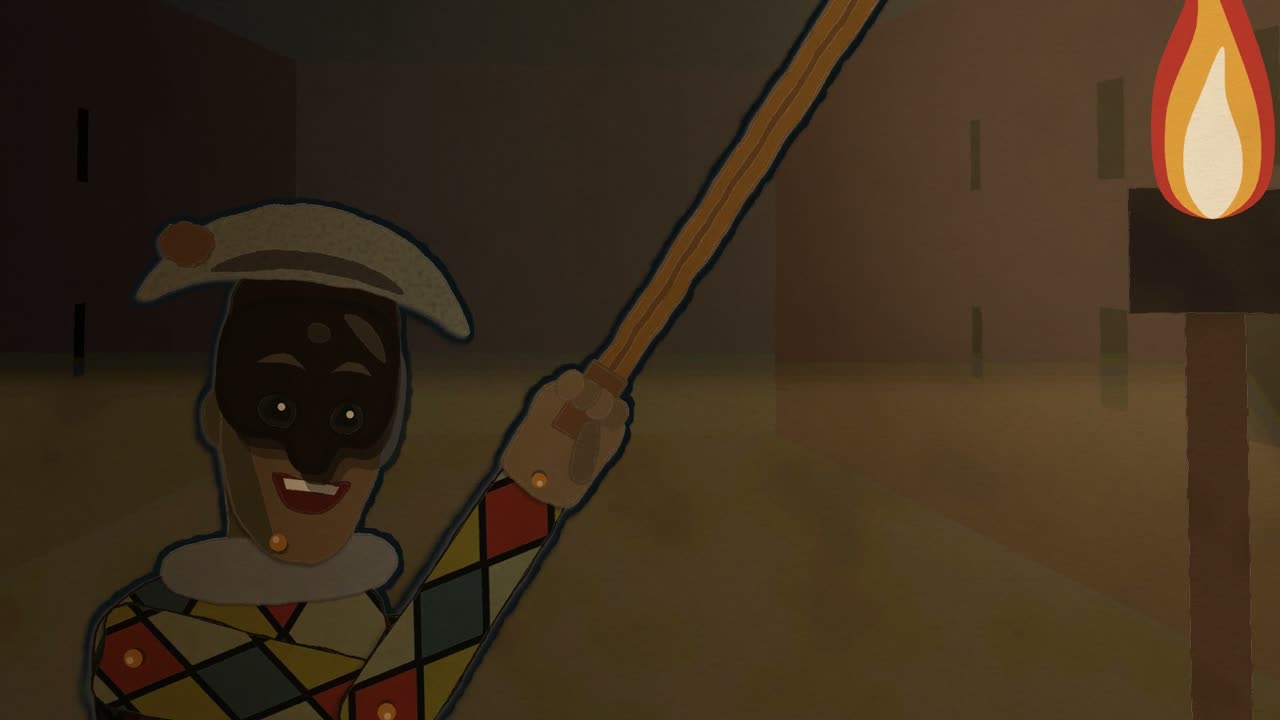
The first zanni is usually Brighella, the clever one: a scheming rogue ready to do anything for money. [16][17] The second is usually Arlecchino, Harlequin: always hungry, always in trouble, quick to escape it and slow to think about the consequences. [16][17]
His coat began as rags and patches that later became regular coloured shapes, triangles and then the famous diamonds. [18] And in his belt he carried a strange wooden bat.
Where does the word slapstick come from?
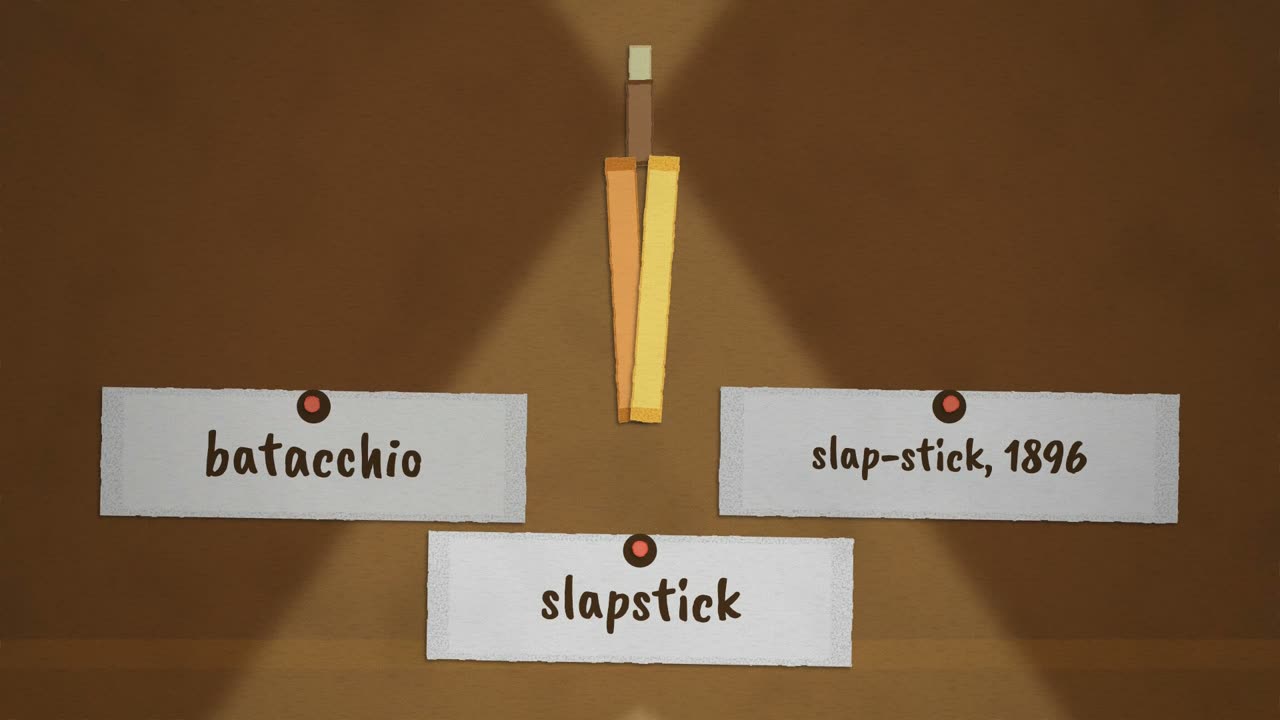
Harlequin's bat was the batacchio: two flat slats joined at one end, which clap together with a loud crack when you swing it at somebody. In English it became the slap-stick; the Oxford English Dictionary's first example is from the New York Dramatic News of 4 July 1896. [19] Soon it named a whole kind of comedy, after Harlequin's bat.
The maid: Columbina
Columbina (Colombina) is the maidservant and Harlequin's sweetheart, often the shrewdest servant on the stage. She usually played without a mask. [20][14]
The masters: Pantalone and the Doctor
Pantalone is the old Venetian merchant, miserly and lecherous. [14] He looks a lot like the mean man of the Greek writer Theophrastus (more on him below), though no record proves one descends from the other.
Il Dottore, the Doctor, is the pedant from Bologna. He spouts learning and Latin, stands between the young lovers and their happy ending, and is the foil to Pantalone. [14][21]
The young lovers
The young lovers are the couple whose happy ending the Doctor keeps standing in the way of. [21] Like Columbina, they usually played without a mask. [14]
The Captain: Il Capitano
Il Capitano is the braggart soldier, all swagger and no courage. His model goes back to Rome: Plautus's boastful soldier, the Miles Gloriosus, became a model for later swaggering cowards, the commedia's Captain among them. [11]
Scaramouche
Scaramouche (Scaramuccia) was big enough that in 1730 a German critic called him and Harlequin the eternal main persons of the Italian stage. [3] In Paris, the actor Tiberio Fiorilli played him without a mask and relied little on words. [11]
Pedrolino, who became Pierrot
Pedrolino is the type usually traced behind Pierrot, who appears in Paris in the 1660s and 1670s. [11]
Pagliaccio, and a note on the word clown
There was also a white-faced servant role, Pagliaccio, recorded in Florence in 1598. [22] The Turkish word palyaço comes straight from him. [23] The English word clown does not: it dates from the 1560s and first meant a rustic, a country clod, of obscure origin. [24] Exactly what the zanni were.
How do you get rid of a clown?
Types like these are hard to kill. In 1737, somebody tried.
Leipzig, autumn 1737. Outside the city's Grimma Gate stands the theatre booth of Caroline Neuber, actress and manager of her own company. And one October night, the story goes, her company throws its own clown off the stage. [1][2]
Keep those words in mind: its factual basis is still disputed, the text of the play is lost, and not one eyewitness account has survived. [1][2] Later tellings improved the scene: one had a Harlequin doll burned on a bonfire, one had him buried, one had Poetry herself kill him in a duel. None of these has an early source; they are legends. [2]
Behind her, in the tale, stands a professor, Johann Christoph Gottsched. In 1730 he had put his dislike in print. Harlequin and Scaramouche, he wrote, make the rabble laugh "with foolish clothes, strange postures and ugly faces" (our translation). He even sneered at the costume: what master would not be ashamed to dress his servant in such motley? [3]
Neuber had already signed up for the cause. In 1734 she promised the elector that her company would avoid plays mixed with the clown's capers, and that the aim was not so much to make the audience laugh as to improve them. [2] A comedy company, promising not to be funny.
Something did happen. In 1742 a satire by J. C. Rost already spoke of the woman who had banished the German Harlequin from her company. [2] But who drove it is disputed. A rival account from 1759 says Neuber's own husband had played Harlequin himself, badly, and had his actors chase him off the stage, "very heroically". [2]
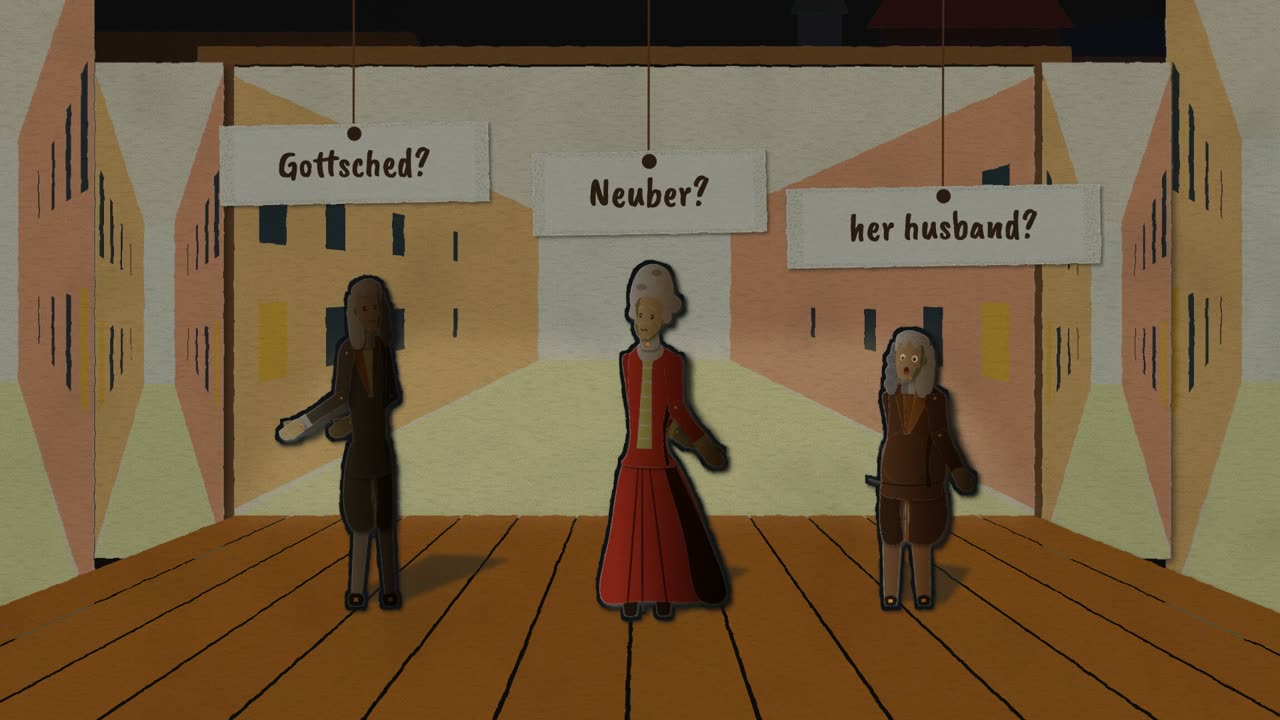
So we don't know exactly what happened in that booth. We do know how it came out. The clown won.
Lessing: the greatest harlequinade ever played
The best review of the whole affair came from Gotthold Ephraim Lessing, who as a student in Leipzig in the 1740s had often been in touch with Neuber. [2] In 1759 he wrote that Gottsched had Harlequin solemnly driven off the stage, and that this was itself the greatest harlequinade ever played. [4]
Eight years later, in 1767, he noticed something better. The stages, he wrote, had only abolished the coloured jacket and the name, and kept the fool. Neuber's own clown had simply been renamed Hänschen and dressed all in white instead of patches. Then the line that closes the case: "Neuber is dead, Gottsched is dead too: I think we should put his jacket back on him." (Our translation.) [5]
Why couldn't they get rid of him? If you ask us, they aimed at the wrong target. You can sack an actor. But the clown was never a man. He was a type.
Character vs type: what makes a stock character
A character is a person: layered, able to change by the last page. A type is one trait wearing a body: the miser, the braggart, the know-all. A type never learns: you know exactly what he will do, and you laugh when he does it anyway.
Some of the first types written down are about 2,300 years old. In Athens, Aristotle said tragedy shows people better than us and comedy shows people worse. Not evil, he added: laughable, a flaw or an ugliness that does no real harm, like the comic mask, "ugly and distorted but not painful". [6]
Aristotle meant character. Later readers heard rank: better meant kings, worse meant everybody else. That rule, kings in tragedy and ordinary people in comedy, is a later Renaissance and Baroque reading, as we read the sources. [6][3] Gottsched is a perfect example: tragedy, he wrote, shows "the heavy falls of the great of this world", and comedy is for citizens, servants and maids, since mocking the great offends the respect owed to them. [3]
Aristotle's student and successor, Theophrastus, then wrote a little book called Characters: thirty short sketches, each a single flaw. [7][8] His mean man docks a broken pot from his servant's food and won't let his wife lend the neighbours salt. [8] He'll be back, richer, in Venice.
Tradition says Theophrastus taught Menander, the master of New Comedy. [8] On that stage the types wore masks, forty-four of them by the count of a later writer, Pollux. [9] Rome had its own fixed fools in the Atellan farce, such as Maccus the fool and Pappus the old man [10], and Plautus's braggart soldier became a model for the commedia's Capitano. [11]
Are these the commedia's grandfathers? A direct line "cannot be established by factual records, for there are no texts, no direct evidence", as Marvin T. Herrick put it. [12] After Rome, the records go thin for over a thousand years.
Padua, 1545: where the commedia dell'arte begins
Then, a date. Padua, February 1545: eight men led by Ser Mafio sign a notarial contract that binds them into a "fraternal compagnia" of actors. As far as anyone knows, it is the first contract of a professional comedy company. [13]
These companies lived on what the audience paid. They improvised around a plot outline instead of a full script, and they played in squares as well as halls. [13][14] People at the time called it improvised theatre, or the comedy of the zanni; the name commedia dell'arte only appears in the eighteenth century. [13] As we see it, what the paying crowd wanted was the same few faces night after night.
Harlequin takes the road
The family didn't stay at home. In Paris in 1584 and 1585, Tristano Martinelli is the first actor definitely known to use the name Arlequin, borrowed from a French folk devil, Hellequin. [25] A clown named after a demon.
From 1658, Molière's company took turns with the Italian company of Tiberio Fiorilli, Scaramouche, on the same Paris stage. [11] In London, from 1717, the manager John Rich played Harlequin under the name Lun. Harlequin had been a speaking part in England; Rich made him silent, two centuries before film. [26]
Meanwhile the clown kept changing names. In Vienna, Josef Anton Stranitzky made Hanswurst, roughly "Jack Sausage", a star in the early 1700s, and Kasperl later followed him. [27][15] Paris had its Pierrot. [11]
Not every funny man is Harlequin's child, though: no documented source links Spain's gracioso or Shakespeare's Falstaff to him. Cousins, not children.
In Italy, Carlo Goldoni wrote plays without masks or improvisation; in January 1761 Carlo Gozzi answered in Venice with The Love for Three Oranges, masks and all. [11] Through the later 1700s the masked companies faded. [11] The types didn't: they were waiting for a stage nobody had invented yet. (How pictures first learned to move is its own story: Muybridge's horse in motion.)
Why silent film needed commedia dell'arte characters
Picture making a comedy around 1910. No sound, so no jokes or wordplay. Most films were a single reel of about 1,000 feet, roughly ten to fifteen minutes. [28] Your audience could be anywhere, speaking anything. You need somebody they understand in one second. A type.
You will often hear that cinema grew up by escaping the theatre. Susan Sontag described that view in 1966, "The history of cinema is often treated as the history of its emancipation from theatrical models", and then added: "But this view is far too simple." [29] In comedy, we would say, the first great film clowns didn't run from the stage. They raided it.
Max Linder, the gentleman in trouble
Max Linder was born Gabriel Leuvielle on 16 December 1883 at Saint-Loubès, near Bordeaux. [30] By 1907, in Pathé's Les Débuts d'un patineur, he was already, in Mariann Lewinsky's words, "the complete Max, all elegance and mishap in a top hat." [31] Before the First World War he was one of the best-known film comedians in Europe. [32]
Our reading: the old stage laughed at the rich man through his servant. Linder made the gentleman himself the clown, and put him on your side.
The mirror gag in his Seven Years Bad Luck (1921), which he wrote, directed and produced, is widely cited as a model for the mirror scene in Duck Soup (1933). [33] Linder died in 1925.
Charlie Chaplin, the disciple
In 1908 a young Charlie Chaplin joined Fred Karno's pantomime company in London, and from 1910 to 1913 he toured America with it. [32][34] In 1913, while he was touring America with Karno, Keystone signed him. [35] (How the American film business ended up out west is another story: why Hollywood is in California.) Audiences first saw the Tramp in Kid Auto Races at Venice, directed by Henry Lehrman and released on 7 February 1914. [35]
A tramp with a gentleman's manners: to us, the servant and the dandy in one body, Harlequin and Max. Chaplin never put it that way, but he did name his master. On 12 May 1917 he signed a photograph: "To the one and only Max / The Professor / From his Disciple / Charlie Chaplin." [31] In 1922 the Paris magazine Cinéa called Linder the man Chaplin calls his master. [36]
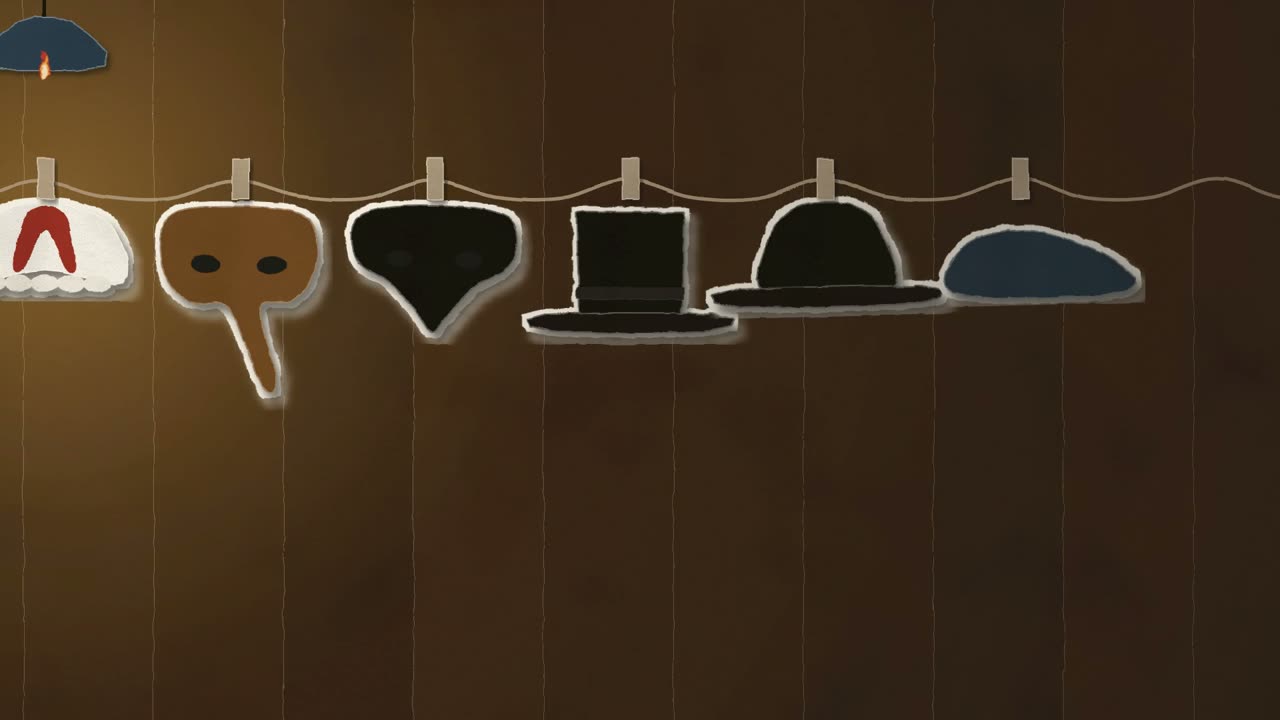
A short piece of film from 1917 even shows Linder doing the Tramp's walk with Chaplin beside him. [37] How much Chaplin actually took from Linder, historians still argue. Around them, Buster Keaton, the Great Stone Face, and Harold Lloyd, the eager young man in horn-rimmed glasses, found the same answer: one look, and you know who he is. [38][39]
Kemal Sunal: Şaban and the Tramp
Kemal Sunal, born in 1944, became what one thesis calls a school of its own in Turkish film comedy. [34]
In 1975 he played İnek Şaban in Hababam Sınıfı, a comedy about an unruly school class, and he kept playing Şaban. [34] A countryman pushed into the city: the zanni again, if you ask us, down from the hills above Bergamo.
Unlike almost every clown in history, Sunal wrote down his family tree. Nobody was studying his work, he said, so the job fell to him; after a failed first attempt, in 1998 his master's thesis on his own comedy, TV ve Sinemada Kemal Sunal Güldürüsü, was accepted at Marmara University. In it he compares Şaban with Chaplin's Tramp: pushed into an order that isn't his, Şaban, "just like the Tramp", passes through it. [34]
You have met all of them
You know these people. Pantalone is the boss who cuts your budget and never his own; the Doctor now has a podcast. On television, as we see it, Mister Burns is Pantalone to the last coin, Frasier Crane is the Doctor with a radio show, and Bugs Bunny is Harlequin with longer ears. And on the record, four villains of the game Genshin Impact openly carry commedia names, Il Dottore, Pantalone, Columbina and Arlecchino. [40]
Put the jacket back on him
So, how do you get rid of a clown? You can't. You can throw out the actor, rename him, write a book of rules against him. But a type isn't a person. It lives in the audience, and the audience brings it back every night. Lessing, it turns out, was right: put the jacket back on him.
Sources
- Neue Deutsche Biographie 19 (1999), "Neuber, Friederike Caroline". https://www.deutsche-biographie.de/sfz71245.html
- "Die Verbannung des Harlekin vom deutschen Theater", Die Grenzboten, 1877, vol. III, pp. 482 to 485 (quoting J. C. Rost, Das Vorspiel, 1742; Briefe, die Einführung des englischen Geschmackes betreffend, 1759; Neuber's petition of 1734).
- Johann Christoph Gottsched, Versuch einer Critischen Dichtkunst (Leipzig, 1730), pp. 567, 590, 596 to 602, Deutsches Textarchiv.
- Gotthold Ephraim Lessing, 17th Literaturbrief, 16 February 1759, in Analekten für die Litteratur I (1785), pp. 207f. https://ndl.uni-freiburg.de
- Gotthold Ephraim Lessing, Hamburgische Dramaturgie, 14th and 18th Stück (16 and 30 June 1767), Projekt Gutenberg. https://www.projekt-gutenberg.org
- Aristotle, Poetics 1448a, 1449a, trans. W. H. Fyfe (Loeb, 1932), Perseus Digital Library.
- Britannica, "Theophrastus"; "Charakteres".
- The Characters of Theophrastus, trans. Charles E. Bennett and William A. Hammond (1902), introduction and contents, Project Gutenberg 58242. https://www.gutenberg.org/ebooks/58242
- Pollux, Onomasticon IV.143 to 154, via Monaghan, Didaskalia 5.1.
- Oxford Classical Dictionary, "Atellana".
- Britannica, "Miles Gloriosus", "Capitano", "Tiberio Fiorillo", "Pedrolino", "Carlo Gozzi", "commedia dell'arte".
- Marvin T. Herrick, Italian Comedy in the Renaissance (1960); M. A. Katritzky, The Art of Commedia (2006).
- Sapienza Università di Roma, course handout "Professionisti e dilettanti", p. 1.
- The Metropolitan Museum of Art, Heilbrunn Timeline of Art History, "Commedia dell'arte"; Britannica, "Pantalone".
- Britannica, "zanni"; World Encyclopedia of Puppetry Arts (UNIMA).
- World Encyclopedia of Puppetry Arts (UNIMA). https://wepa.unima.org/en/?p=8060
- Shakespeare Theatre Company, "A Gallery of Rogues"; Palomar College, "Commedia characters".
- ArtsEmerson, "The comedy of craft"; Britannica, "Harlequin".
- Grammarphobia, January 2019, citing the Oxford English Dictionary and Merriam-Webster.
- Britannica, "Columbine"; Shakespeare Theatre Company, "A Gallery of Rogues".
- Britannica, "Dottore".
- De Nieuwe Gids, 1918.
- TDK, Güncel Türkçe Sözlük, "palyaço".
- Etymonline, "clown"; Anatoly Liberman, OUPblog, 2 October 2024.
- World Encyclopedia of Puppetry Arts (UNIMA). https://wepa.unima.org/en/?p=6547
- Victoria and Albert Museum, John Rich drawing. https://collections.vam.ac.uk/item/O1160199 ; Britannica, "John Rich".
- Deutsche Biographie, "Stranitzky, Josef Anton"; "Laroche, Johann".
- Benjamin B. Hampton, A History of the Movies (1931), Media History Digital Library (Lantern).
- Susan Sontag, "Film and Theatre", The Tulane Drama Review 11:1 (Autumn 1966), p. 24.
- Pringle, "Silent Star of August 1996", Monash University.
- Mariann Lewinsky, Il Cinema Ritrovato programme note on La Terroriste.
- Le Giornate del Cinema Muto 2019, "European Slapstick, Programme 1".
- AFI Catalog and TCM, Seven Years Bad Luck (1921).
- Efe Teksoy, MA thesis, İstanbul Kültür University (2015), pp. 30 to 33, 37, 44 to 45, quoting Kemal Sunal, TV ve Sinemada Kemal Sunal Güldürüsü, Marmara University (1998), pp. 25 to 26; and Gül Sunal, Kemal Hadi Gel, Bi Kahve İçelim (2014), p. 28.
- Charlie Chaplin official site, Kid Auto Races at Venice. https://www.charliechaplin.com/en/films/47 ; Library of Congress, National Film Registry 2020.
- Cinéa (Paris, 1922), Media History Digital Library. https://lantern.mediahist.org/catalog/cina22pari_0740
- Connelly, The New European, 31 October 2017; "Max Linder Visits Charlie Chaplin", official Charlie Chaplin YouTube channel.
- Britannica, "Buster Keaton".
- The Criterion Collection, "100 Years of Harold Lloyd's Glasses Character".
- HoYoverse, teaser "A Winter Night's Lazzo" (2022), as reported by Inverse and Sports Illustrated.