The Jaws Mechanical Shark Barely Worked: Why You Rarely See It in the Film
Jaws' mechanical shark, nicknamed Bruce, kept failing in salt water, so Spielberg wrote it out of scenes. What the record says, and which legends hold up.

You rarely see the shark in Jaws because the mechanical shark barely worked. The machines, three of them, all nicknamed Bruce, had been tested in a freshwater tank in California [1][5]. On location in the Atlantic, salt water got into their electronics, and they failed again and again [1][2]. A shoot planned for 55 days of filming ran 159 calendar days [1][8]. So Steven Spielberg shot what he could without the shark, and the writers rewrote it out of scene after scene [1]. Yellow barrels, a fin and the score did the job instead. Spielberg names Alfred Hitchcock as his model, and in 2022 he called the breakdowns "good fortune" [1][3][4].
That's the famous story, and most of it holds up. But not all of it. Here it is, checked against the record.
Spielberg's Jaws shoot, 1974
It's the second of May, 1974. A film crew arrives on Martha's Vineyard, an island off the coast of Massachusetts, to shoot a story about a shark [1][8].
The director is Steven Spielberg. He's twenty-seven. His first film for cinemas, The Sugarland Express, made in 1974 for the same producers, Richard D. Zanuck and David Brown, hadn't done well [1][8]. In his own words, he was a director whose first picture had failed at the box office [1].
And now he was staking his next one on a shark made of machinery.
Three sharks named Bruce
Start with the plan, because this is the part the legend usually skips: nobody set out to hide this shark.
The film's production designer, Joe Alves, and his team built three full-size sharks [1][8]. Not one. Three. Each was made to be filmed from a different angle:
- A full shark, towed through the water on a sled.
- Two platform sharks, each built to be seen from one side only. One moved left to right, the other right to left. The hidden side of each was open, showing the hoses [8].
Alves, in his own short version of it, remembers one of them "on a big crane" [2]. The longer accounts describe a sled and two platforms.
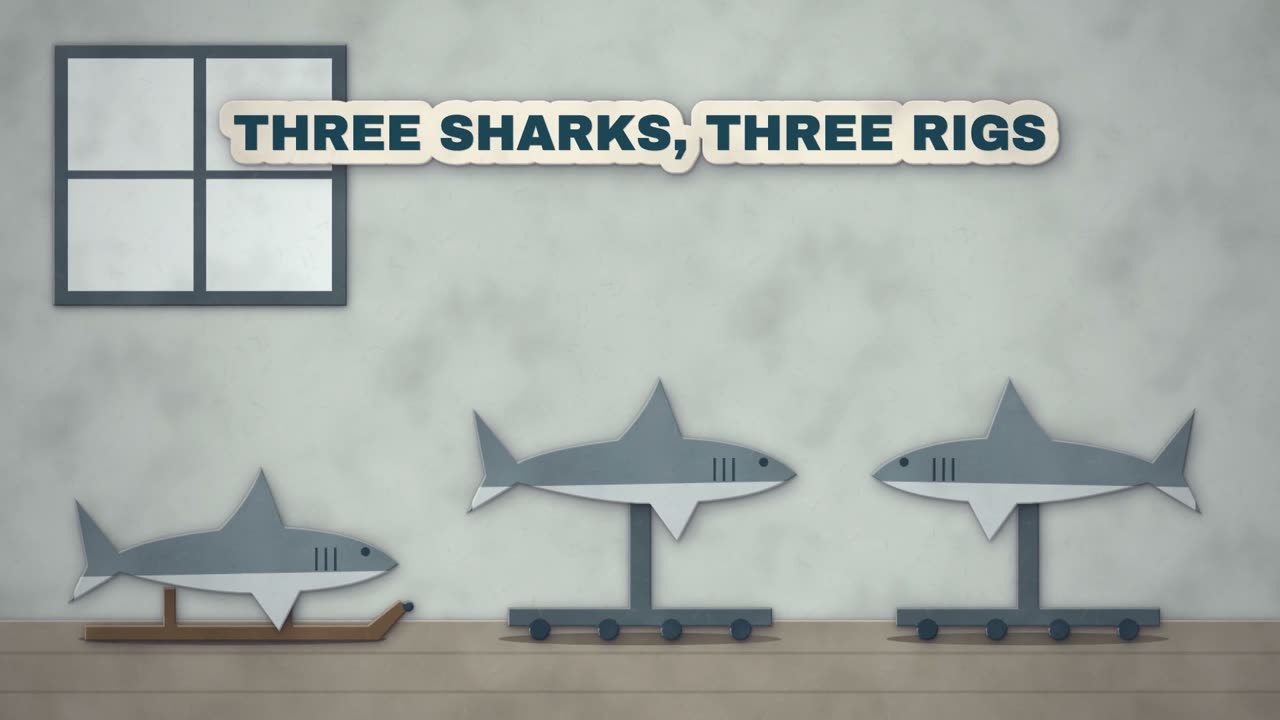
You don't build all that to keep your shark off the screen. That's our read, and it's the first crack in the legend.
Spielberg gave the three of them one name between them: Bruce, after his lawyer, Bruce Ramer [1][5]. A friendly name for a machine that was about to cost everyone a great deal of time.
Why shoot Jaws in the ocean at all?
A shark like this could have been filmed in a studio tank. When Sid Sheinberg of Universal, the studio, came out to the shoot, he asked Spielberg to consider exactly that. Spielberg said no: "I wanted to shoot this in the ocean for reality." [1]
Alves remembers Spielberg wanting it from the start: a big, full-sized shark, 25 feet long, in the real ocean, not in the backlot tank [2].
Sheinberg's reply is one of the best lines in the whole story: "Reality is costing us a lot of money." [1] He was not wrong.
Tested in fresh water, in a hurry
The sharks were built in California, in a hangar in the San Fernando Valley, and tested there in a freshwater tank [1]. In the tank, they worked.
But there wasn't much time to test them. Benchley's novel came out in February 1974 [2], and Alves remembers the studio telling them: "We're going to start shooting in two months." In his view, that's why they had all the problems with the shark: there was no time to test and develop it [2]. (Michael Schulman's account ties the timing of the start to a possible actors' strike [1].)
What went wrong with the mechanical shark?
So the sharks went east, to the Atlantic. And the Atlantic is salt water.
As Alves puts it, salt water doesn't like electrical stuff [2]. The salt got into the electronics and corroded the sharks from the inside [1][2]. Nobody had counted on that.
The test where the shark flipped over
The trouble started early. At one test on the Vineyard, the executives came out to watch: the producers, and Sid Sheinberg from the studio. The shark went into the water in front of all of them, and it flipped over [1].
Alves remembers it plainly: "It was embarrassing. It didn't work." [1]
You may have read that the shark "sank on day one". That's the popular retelling. The account we could trace, Alves's own, says it flipped over at an early test [1].
Every single day
That wasn't one bad day. It was the pattern. Bill Gilmore, a production executive on the film, described May and June this way: "Every single day the shark was put in the water, something went wrong." [1] A hose burst. The shark on the sea sled ran aground [1].
Picture what that means on a film set: a whole crew, boats and cameras, out on the water, everyone waiting for one machine. And the machine isn't ready. Again.
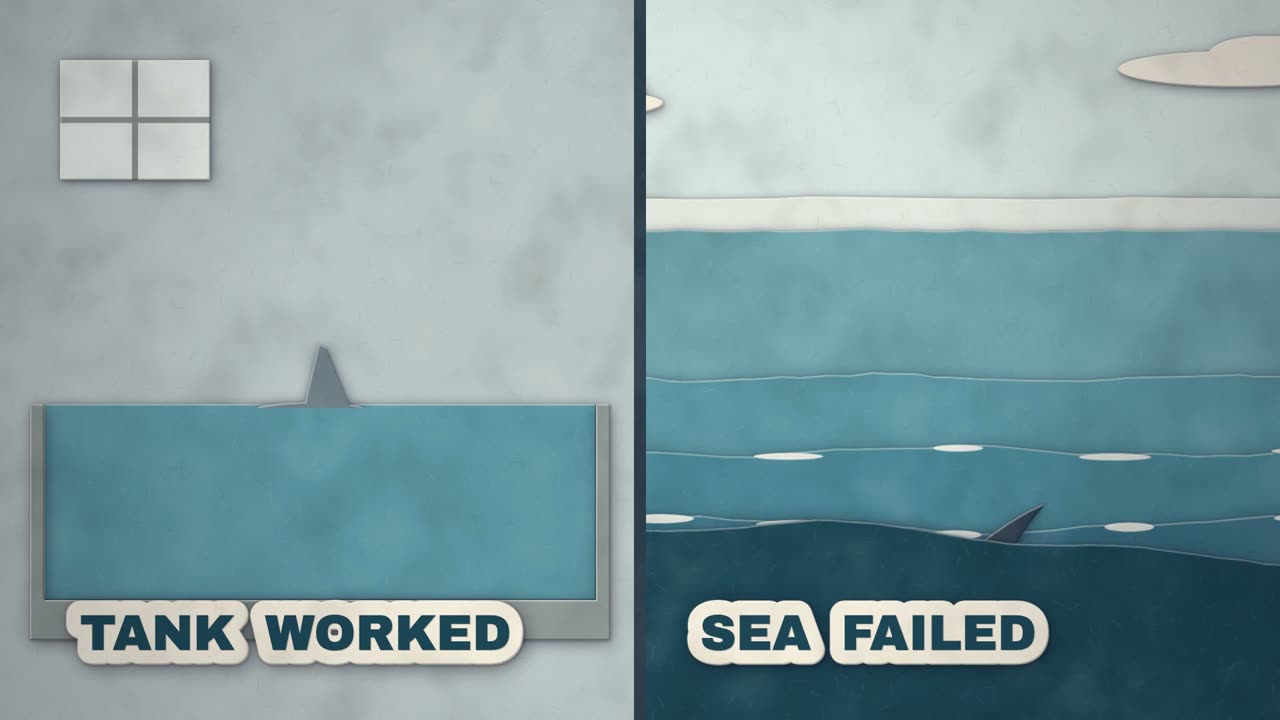
So, the first check on the legend. "The shark never worked" is too strong. In the tank in California, it worked. At sea, it failed again and again. The fair version: it barely worked.
55 days became 159
Every day it failed, the calendar kept moving.
The plan was 55 days of filming, on a budget of roughly three and a half to four million dollars [1][8]. Sources differ on that figure: Schulman gives $3.5 million [1]; the producer David Brown, as quoted in a later book, said $4 million [7].
Fifty-five days of filming came and went. The shoot kept going, through July, through August, and didn't end until early autumn 1974. Counted on the calendar from that second of May, it ran 159 days [1][8].
One catch: those are calendar days, not days of filming, so "159 shooting days" isn't what the sources say. They also differ on the wrap date (6 October in one biography [8], September in Schulman's account [1]), so we don't pin a day on it.
How much did Jaws go over budget?
Sources differ again. David Brown later put the final cost at around nine million dollars, by his own count [7]. Whichever starting figure you take, that's more than double the plan.
By then the crew had their own name for the film. Not Jaws. Flaws [1].
"I thought my career as a filmmaker was over"
For Spielberg, this was personal. One cinema film behind him, and it hadn't done well. Years later he admitted it: "I thought my career as a filmmaker was over." Nobody, he said, had ever taken a film a hundred days over schedule [1].
Look at it from where he stood. Over schedule, over budget, the studio watching, and the star of the film keeps breaking down. He could have kept fighting to get the shark on camera. He went the other way.
Writing the shark out of Jaws
While the shark was out of action, Spielberg shot everything he could without it. And on the island, the script was being rewritten as they went [1][8]. One of the writers, Carl Gottlieb, put the logic simply:
"If we don't absolutely have to see the shark, why make trouble for ourselves?" [1]
So, scene by scene, they started writing the shark out.
Barrels, a fin and the score
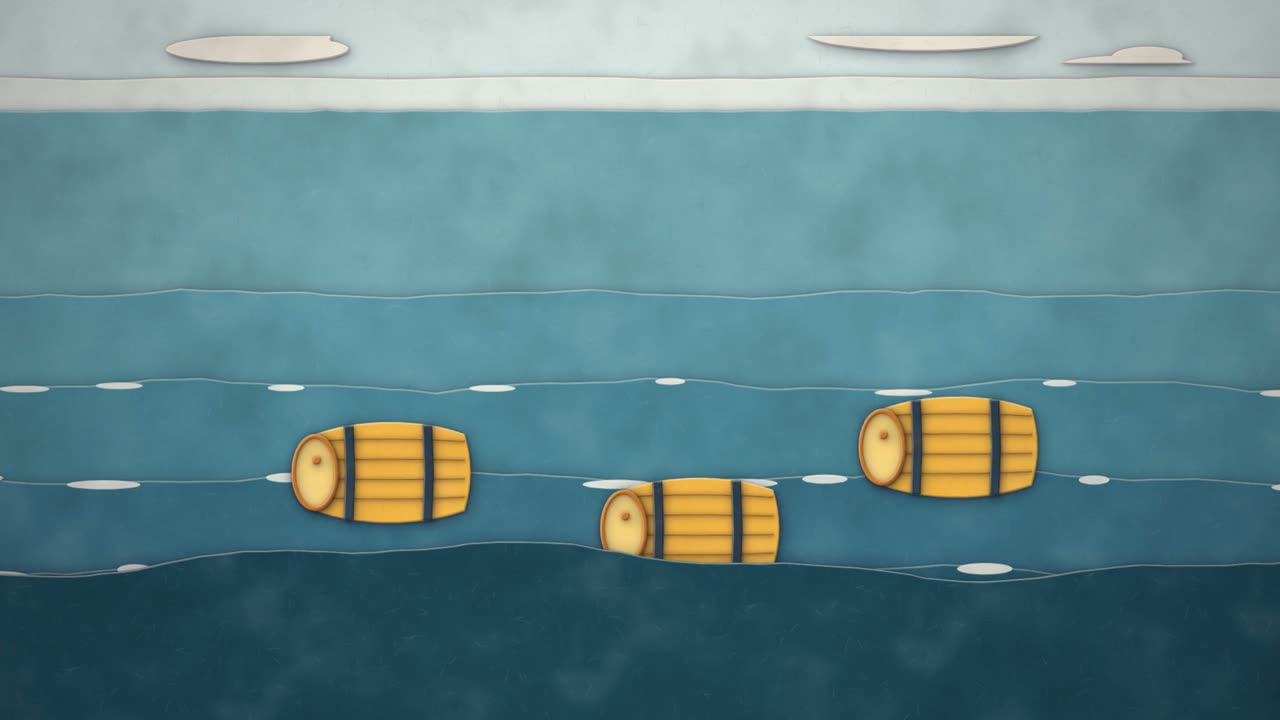
In the finished film, as accounts of it describe, during much of the hunt what you're watching isn't the shark. It's the yellow barrels. They sit on the surface and tell you exactly where the shark is, without ever showing it to you [8].
Elsewhere it's a fin. Or the view from under the water, looking up at the swimmers. And the music does the rest: the score tells you the shark is coming, so the picture doesn't have to [8].
That's the whole trick, in our view. The shark stops being something you look at. It becomes something you wait for. And the waiting is worse.
Did Spielberg invent the unseen shark?
He doesn't claim he did. He has said where it came from: "I just went back to Alfred Hitchcock." He was imagining a Hitchcock movie instead of a Godzilla movie. In his words: "It's what we don't see which is really truly frightening." [1]
In 2022, on the BBC radio programme Desert Island Discs, he put it this way. He'd had to be resourceful, he said, to create suspense and terror without seeing the shark itself. Hitchcock did that [3][4]. And then this:
"It was just good fortune that the shark kept breaking." [3]
So the core of the legend holds. The shark broke, he kept it out of sight, and he'll tell you himself it was luck. But luck only helps if you know what to do with it. He had a model ready, and he says whose it was.
Were the barrels in the Jaws novel?
Now for the part the legend leaves out. Jaws was a novel first, by Peter Benchley, published in 1974 [2]. Readers who have set the book beside the film point out that the barrels are already in it: wooden barrels on the bow of Quint's boat, the Orca (ten of them, by one reader's count), and Quint explains what they're for [6].
That comes from those readers' account of the book, not from a reading of our own, so take it as theirs.
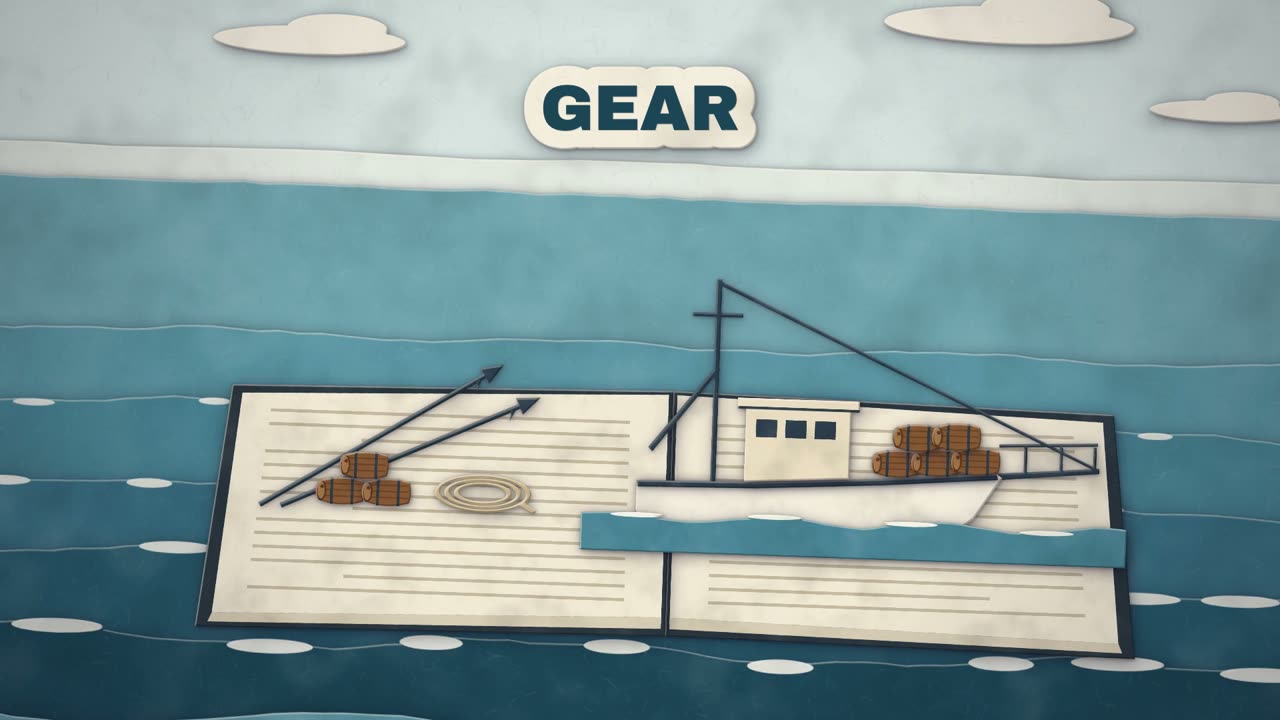
But in the book, by that account, they're gear: part of the hunting kit, and not the part anyone remembers [6]. In the film, they stand in for the shark. The barrels were already there. Using them as the shark was the new part.
And here's the twist. By the same readers' account, the novel doesn't hide its shark. In the very first chapter, it attacks a swimmer, and Benchley describes it, head and all [6]. So the hiding didn't come from the book. The book gave the barrels. The broken machine made them the star.
How long is the shark on screen in Jaws?
You've probably read a figure for how many minutes the shark is actually on screen. We went looking for where that number comes from, and no published count we found has a source.
So the honest answer: no one has counted it reliably. What you can see, without a stopwatch, is the shape. For long stretches, the shark is barrels, a fin, a patch of moving water. And you, waiting for it.
The Jaws shark legend, checked
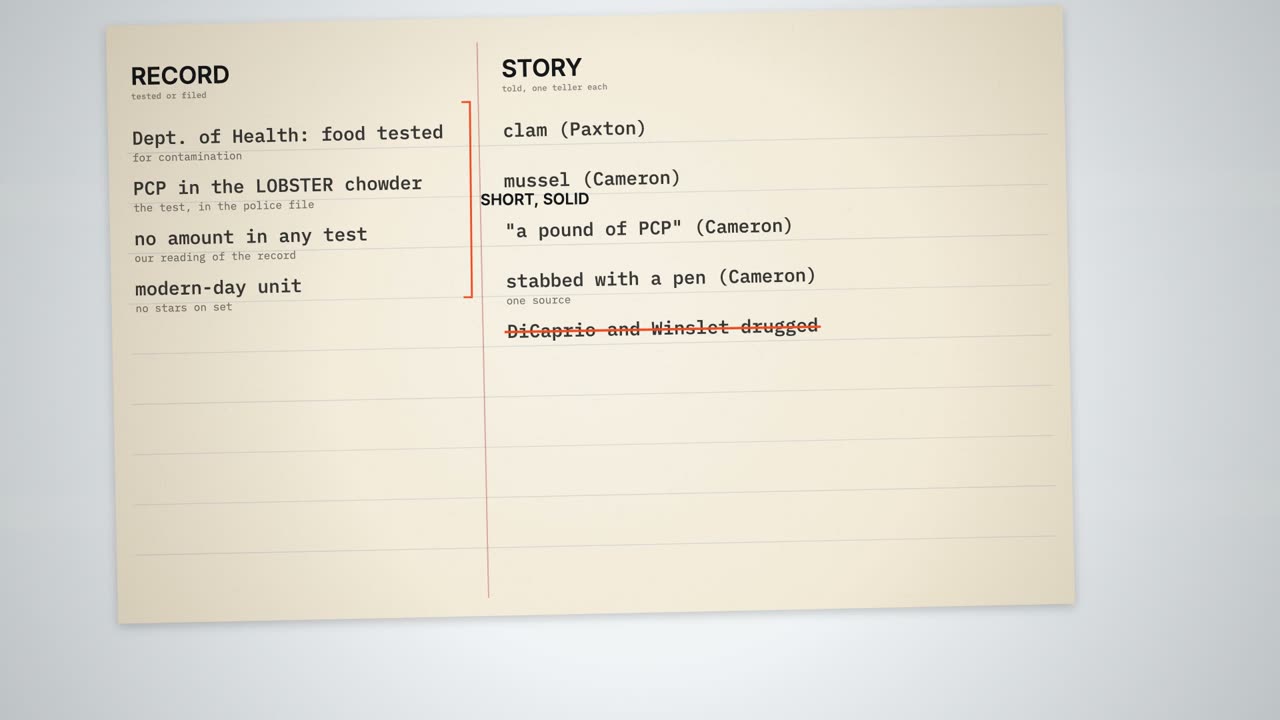
Here's how the popular version holds up, checked the way we checked the story of how Toy Story 2 was deleted and the PCP chowder served on the Titanic set.
- "The shark failed at sea, again and again." True. Salt water got into the electronics [1][2], and by Gilmore's account something went wrong every day it went in the water [1].
- "The shark never worked." Too strong. It worked in the freshwater tank in California [1]. At sea, it barely worked.
- "The shoot ran far over, and cost far more." True, though the numbers differ by source: about 55 planned days of filming against 159 calendar days [1][8], and about $3.5 to 4 million planned against about $9 million by David Brown's count [1][7][8].
- "Spielberg hid the shark, and it made the film scarier." True, in his own words: he calls it good fortune [3][4].
- "Spielberg planned the unseen shark all along." The opposite. They built three sharks to be filmed [1].
- "Spielberg invented the unseen monster." He names Hitchcock as his model [1][3].
- "A 26-year-old Spielberg made Jaws." Half true. He was 26 when he was hired; by the 1974 shoot he was 27 [9].
- "The barrels were Spielberg's invention." Readers who compared the two say the barrels are already in the novel, as gear [6]. Using them as the shark was the film's idea.
- The famous figure for the shark's minutes on screen. No source we could find measured it.
Count the barrels
You rarely see the shark in Jaws because the mechanical shark kept failing at sea, and the people making the film chose to work around it rather than wait for it. Spielberg had been given a shark to film. What he got was a machine that kept failing to show up. So he made the audience do the work. Every barrel, every fin, every quiet stretch of water: you fill in the shark yourself. And the one you imagine is always worse.
Next time you watch Jaws, keep an eye on the water, not the shark. Count the barrels. That's where Bruce really is.
Sources
- Michael Schulman, Oscar Wars (Harper, 2023); excerpt "How a 26-Year-Old Steven Spielberg Made Jaws… and Nearly Lost His Career in the Process", Literary Hub, 24 February 2023. https://lithub.com/how-a-26-year-old-steven-spielberg-made-jaws-and-nearly-lost-his-career-in-the-process/
- Adam Pockross, "Jaws at 45: Joe Alves designed Bruce the shark" (interview with Joe Alves), SYFY WIRE, 1 June 2020. https://www.syfy.com/syfy-wire/jaws-joe-alves-interview-45-anniversary
- Steven Spielberg on Desert Island Discs, BBC Radio 4, broadcast 18 December 2022, as quoted by Dark Horizons (via The Hollywood Reporter). https://www.darkhorizons.com/spielberg-on-jaws-regrets-over-shark-harm/
- Miranda Bryant, "Spielberg tells of guilt over harm hit film Jaws may have done to sharks", The Irish Times / The Guardian, 18 December 2022 (programme and date). https://www.irishtimes.com/culture/film/2022/12/18/spielberg-tells-of-guilt-over-harm-hit-film-jaws-may-have-done-to-sharks/
- NPR, "'Jaws' Shark Gets His Bite Back: A Love Story", 9 August 2019 (the name Bruce, after Bruce Ramer).
- "Not Like Going Down The Pond", A Mouth Full of Butcher Knives (a blog reading the novel against the film), 29 May 2011 (the novel's barrels and first chapter). https://jaws1975.blogspot.com/2011/05/not-like-going-down-pond.html
- David Brown on the budget ($4 million planned, $9 million final), as quoted in Priggé (2004), p. 8 (cited via Wikipedia's Jaws article; the book itself not opened).
- Wikipedia, "Jaws (film)", used as a pointer to its cited books: McBride, Steven Spielberg: A Biography (1999), pp. 233 and 241 (start date, 159 days, 6 October wrap, the name Bruce); Gottlieb (2005), p. 52, and Brode, p. 50 (the $3.5 million plan, the rigs, Alves as production designer); the barrels and the score in the finished film.
- Wikidata, Steven Spielberg (Q8877), date of birth 18 December 1946.