What Does a Sound Designer Do? How the Lightsaber and the T. rex Got Their Sounds
What does a sound designer do in film? They make sounds that don't exist out of ones that do, like the Star Wars lightsaber and the Jurassic Park T. rex.

What does a sound designer do? In film, a sound designer makes sounds that don't exist out of sounds that do. Nobody can record a laser sword or a dinosaur, so the sound designer records ordinary, real things, then mixes them, moves them and slows them down until the audience believes them. Today the title covers two kinds of work: inventing the special sounds, like a lightsaber, or shaping the film's whole soundtrack [9].
That's our short answer. The two most famous examples show it: the Star Wars lightsaber, which is a film projector and a television, and the Jurassic Park T. rex, whose roar is built around one baby elephant [1][7].
What a sound designer does on a film
In film, "sound designer" can mean two jobs [9]:
- The person who invents the special sounds, like a lightsaber or a dinosaur.
- The person who shapes the whole soundtrack of a film.
For the first kind, the two stories below follow the same steps:
- Collect real sounds. In the 1970s Ben Burtt was always carrying a portable tape recorder, building a collection of sounds [4].
- Layer them. No single recording is the finished sound. The lightsaber is two sounds mixed about half and half; the T. rex roar is a mix built around one baby elephant [1][6][7].
- Move them. Burtt waved a microphone past a speaker to make the sword swing [1].
- Change their speed. Slow a small sound down and it gets bigger. Gary Rydstrom calls it "one of the secrets of sound design", and it's a working rule of the trade [6][9].
Sound designer vs foley artist, sound editor and mixer
A sound designer doesn't work alone. Next to them are other sound jobs [9]:
- Foley artists perform footsteps and small sounds in time with the picture.
- Sound editors cut the sounds and place them.
- Re-recording mixers balance it all into the final track.
(For another crew job explained, see what a script supervisor does.)
What does a sound designer do? Start in a projection booth
In the first half of the 1970s, Ben Burtt was a graduate student at the University of Southern California's film school, working on a master's degree in production. He started in 1971 and finished in 1975 [3]. He was also a projectionist.
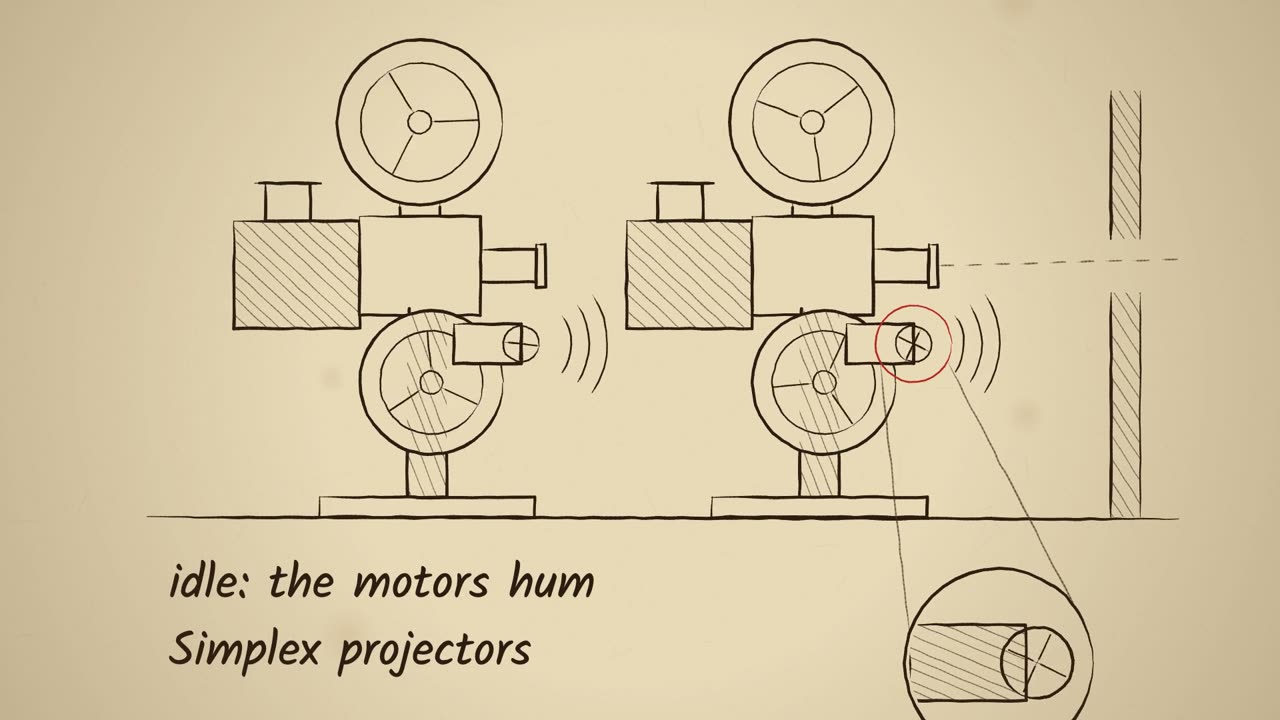
The booth had very old Simplex projectors. While they sat idle, their motors hummed. There were two of them, and in Burtt's words the hum would slowly change in pitch and "beat against another motor" [1]. Two pitches that sit just a little apart drift in and out of step: in step they swell, out of step they fade. Swell, fade, swell. Keep that hum in mind, because it becomes half of the lightsaber.
Around the time Burtt finished his degree, a producer named Gary Kurtz called some professors he knew at USC. He was asking if anyone was interested in recording and making sounds for a science-fiction film. They recommended Burtt [3]. The film was Star Wars (1977) [3][8].
Think about what he was handed. A laser sword doesn't exist, and neither does its sound. There's nothing to go out and record. What Burtt had was a set of paintings by the artist Ralph McQuarrie. Looking at them, he said, he "could kind of hear the sound" in his head [1]. That's the job, before it had a name.
How was the lightsaber sound made?
The lightsaber was the very first sound Burtt made for the whole series [1][2]. He built it in three steps.
Step 1: the projector hum
He knew where to start: that old projector motor at the film school. In his words to Star Wars Insider, he "went and recorded it right away" [2].
Step 2: a buzz from a television
The hum alone, he said, "wasn't quite enough". What was missing was a buzzy, sparkling layer on top [1].
He found it by accident. He was carrying a microphone across a room where a television was on with the sound turned down. The microphone passed right behind the TV's picture tube and picked up a signal from the set. That, in his words, "was a great buzz" [1].
Note what he does not say. A popular version of this story calls it a broken TV, or a broken microphone cable. Burtt's own account names neither: the TV was on, with the sound turned down, and the buzz was a signal the microphone picked up as it passed behind the tube [1].
He then mixed the two, about 50/50: the projector hum and the television buzz. That mix became "the basic lightsaber tone" [1].
Step 3: making the sword move
A lightsaber doesn't sit still. It swings. So Burtt played the tone through a speaker in a room, took a second microphone, and waved it through the air past the speaker [1].
As the microphone rushes toward the speaker, the pitch rises a little. As it pulls away, the pitch drops. That's the Doppler shift [1]. Swing the microphone, and the sword swings. (In our video we drew that pitch bend much larger than life so you can see it; the real bend from an arm swing is small.)
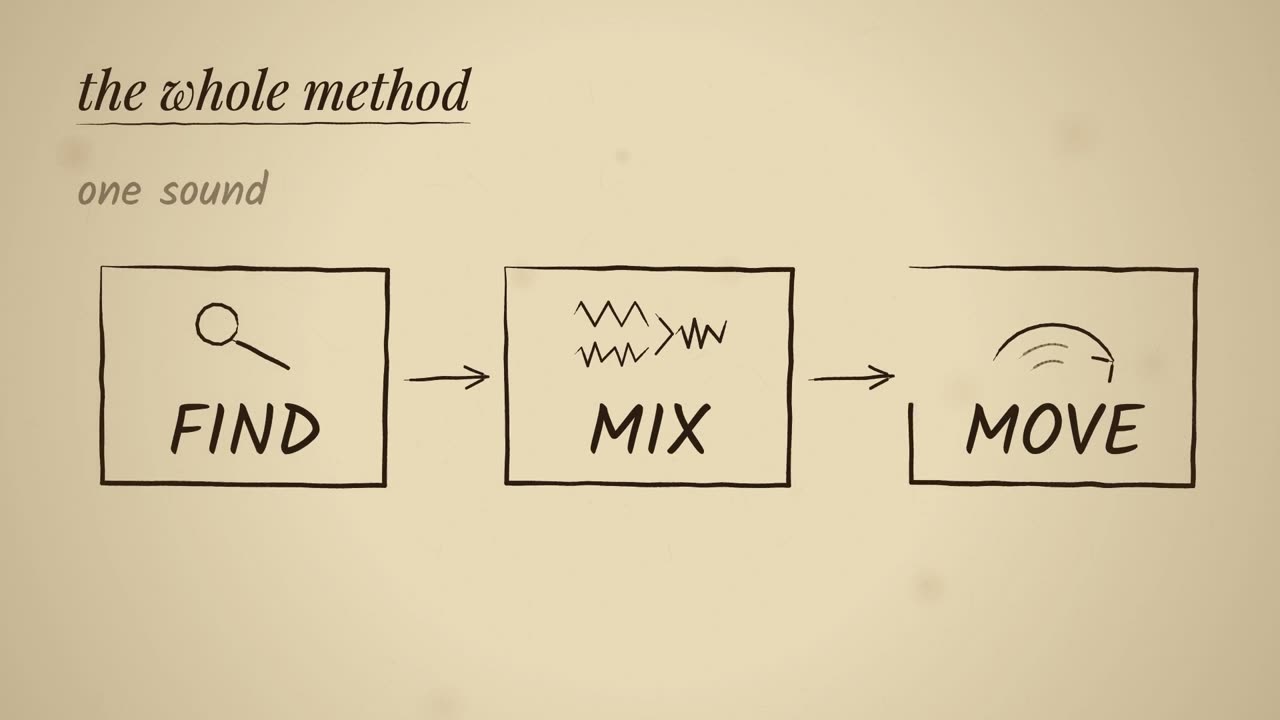
That's one sound, and the whole method is already in it. Find something real. Mix it with something else. Move it. Neither half is a lightsaber. One is a machine in a booth; the other is the kind of buzz you'd normally call a fault in a recording.
Where did the Star Wars laser gun sound come from?
Burtt was always collecting real things. His father, Benjamin P. Burtt, a chemistry professor, wrote down how the laser gun sound began. In those years, he says, Ben was always carrying a Nagra, a portable tape recorder, "getting all sorts of sound for his collection" [4].
On a family trip in the Pocono Mountains, they came to a radio tower. His father picked up a rock and banged on one of the tower's support cables, just for fun. Ben's reply, as his father recorded it: "That sounds like the imaginary laser gun ought to sound!" [4]
Later, Ben went looking for other towers and found one he especially liked in the Mojave Desert. He recorded its cable and used it with other sounds [4].
You may have read that Burtt hit the cables of the Golden Gate Bridge. His father's letter says that version, which appeared in a magazine, is not true: it was a radio tower in the Poconos, then one in the Mojave [4].
So look at the list so far. A projector motor. A television. A cable on a radio tower. Not one of them was built to make a sound.
Who invented the term "sound designer"?
On Star Wars and Apocalypse Now (1979), writes the sound designer Randy Thom, "sound began to shape the picture sometimes as much as the picture shaped the sound." He credits the two films' sound men, Ben Burtt and Walter Murch, with inventing the term. You might assume the job is about making neat sound effects, he writes, but that doesn't describe it very accurately [5]. When the title first showed up in a film's credits is a messier story: the sources we checked disagree on the film and the year.
Try it yourself. Think of a film you love, say Jaws, and picture it with the sound off. It's a different film. That, as we read him, is Thom's point.
How was the T. rex roar made?
Inventing a sword is one thing. But what if nobody has ever heard the thing on screen? As NPR put it, nobody actually knows what dinosaurs sound like [7].
That was the problem for Jurassic Park (1993), sixteen years after Star Wars. Its dinosaur sounds were made by Gary Rydstrom, who won two Academy Awards for his work on the film [6][7].
The trick from his mentor
Rydstrom started with a trick from Ben Burtt, whom he calls "a mentor of mine". For Return of the Jedi (1983), Burtt had made the Rancor beast by slowing down a chihuahua [6][8].
In Rydstrom's words, it's one of the secrets of sound design: if you slow down something small, it brings out elements you could probably never get by recording something big [6].
Here's why it works. Play a recording at half speed and every pitch drops one octave, and the sound lasts twice as long. Small becomes huge.
The T. rex: one baby elephant, recorded once
The T. rex roar is a mix. But its key element, the high scream, is a baby elephant Rydstrom recorded. Not a grown elephant: a baby [6][7].
By NPR's account, the elephant made that sound once, at the San Francisco Zoo. The handlers had never heard it make that sound, and it wouldn't do it again. So Rydstrom used the same tape for every T. rex roar in the film [7].
Some of the T. rex's shaking noises came from somewhere even smaller: his tiny Jack Russell terrier, Buster, playing with a rope toy [6].
Isn't that cheating? It's an elephant, not a dinosaur. But remember the problem: nobody knows what a dinosaur sounds like. So the only test is whether you believe it. In the cinema, you did.
The raptors: tortoises, a horse, a goose and a dolphin
When the raptors bark at each other, you're hearing two tortoises mating. Rydstrom recorded them at Marine World [6].
That's just the bark. The rest of the raptor is a mix [6][7]:
- The breathing at the kitchen-door window is a horse, one he used in three or four dinosaurs.
- The hiss before Muldoon's "Clever girl" is a goose.
- The screams: one key element was a male dolphin.
- A growl from a friend of his is in there too, the only human used to make dinosaur noises.
Notice anything? It's the lightsaber again. No single animal is the raptor, the way no single machine is the saber.
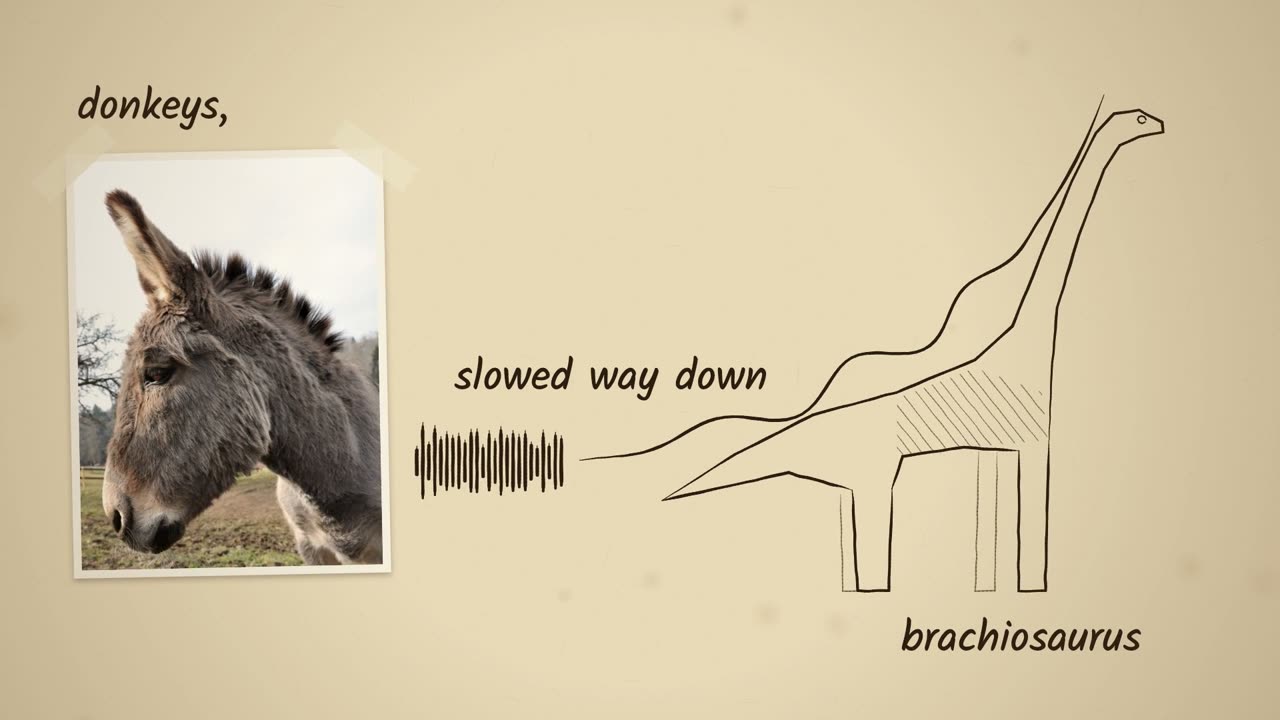
The brachiosaurus: donkeys, slowed way down
The brachiosaurus's singing call is made only from donkeys. "So you slow that way down," Rydstrom told NPR, "and it sounds like song" [7]. Nobody would call a donkey graceful. Slowed right down, it becomes a giant singing.
Movie sound myths, checked
A few versions of these stories travel further than the sources support:
- "The lightsaber hum came from a broken TV." Burtt's own account describes a working TV with the sound down, and a microphone passing behind its picture tube. No broken TV, no broken cable [1].
- "Burtt hit the Golden Gate Bridge cables for the blasters." His father, who was there, says it was a radio tower in the Pocono Mountains, then another in the Mojave Desert [4].
- "The raptors are tortoises." Only the bark is. The raptors are a mix of several animals and one human [6][7].
- "The T. rex is a koala" (or an alligator). Neither Rydstrom interview we read names a koala or an alligator. What both sources agree on is the baby elephant as the key element [6][7].
- "The first sound designer credit was in [year]." Contested. The sources disagree, so we leave it open [5].
So, what does a sound designer actually do?
Go back through the list. A projector motor. A television. A radio tower. Tortoises, a horse, a goose, a dolphin, donkeys, a baby elephant, and a dog with a rope toy. None of them is the sound you heard in the cinema. Each one is raw material.
The sound designer's job is everything in between: the hearing, the mixing, the moving, the slowing down, until the picture believes it.
So next time a film makes you jump, ask what that sound really is. Odds are, it's something ordinary, changed by someone who heard what it could become.
Rydstrom has a line about that: "If people knew where the sounds in Jurassic Park came from, it'd be rated R!" [6] The lightsaber, at least, is safe for all ages. It's only a projector and a television.
A note on our video: every famous sound you hear in it is our own recreation, made in code or from public-domain recordings, never the films' audio. The beating hums and the Doppler bend are drawn and played with our own values, not Burtt's.
Sources
- Ben Burtt on the lightsaber, transcribed from a Star Wars video extra (filmsound.org/starwars/burtt-interview.htm), quoted in full in Miguel Isaza, "Ben Burtt Special: Star Wars – The Sounds [Part 1]", Designing Sound, 3 September 2009. https://designingsound.org/2009/09/ben-burtt-special-star-wars-the-sounds-part-1/
- Ben Burtt, Star Wars Insider #26, quoted in Amy Ratcliffe, "5 Iconic Star Wars Sound Effects and How They Were Made", StarWars.com, 12 January 2016. https://www.starwars.com/news/5-iconic-star-wars-sound-effects-and-how-they-were-made-starwars-com
- "Interview with Ben Burtt, Editor and Sound Designer, Star Wars: Episode II", Editorsnet, via filmsound.org (filmsound.org/starwars/editorsnet-interview.htm).
- Benjamin P. Burtt (Ben Burtt's father, Professor of Chemistry Emeritus, Syracuse University), letter on the laser-gun sound, filmsound.org (filmsound.org/starwars/lasergunstory.htm).
- Randy Thom, "Designing a Movie for Sound", 1999, filmsound.org (filmsound.org/articles/designing_for_sound.htm). The first on-screen "Sound Designer" credit is contested between sources; we give no date.
- Kyle Buchanan, "How the Dino Sounds in Jurassic Park Were Made", Vulture, April 2013 (Gary Rydstrom's own words).
- Becky Sullivan, "Jurassic Bark: How Sound Design Changed Our Imaginations", NPR, 13 April 2013. https://www.npr.org/2013/04/13/177153801/jurassic-bark-how-sound-design-changed-our-imaginations
- Film years (Star Wars 1977, Return of the Jedi 1983): AFI Catalog of Feature Films, catalog.afi.com.
- Professional review of the job today (the two meanings of "sound designer"; foley artists, sound editors and re-recording mixers) and of "slowing a small sound makes it sound bigger" as a working rule: Onur Thornfield, cinematographer, 2026.