What Does a Script Supervisor Do? The Film's Memory, Explained
What does a script supervisor do? They keep the film's memory for the edit: timing, continuity, take notes and the lined script. Plus who stops movie mistakes.

What does a script supervisor do? They keep the record of what was shot, take by take, so that a film shot out of order can be put back together in the edit. One union calls them "the eyes, ears, voice, and memory of the editor" [6].
In practice: before the shoot, they time the script and break it into story days. On set, they sit near the director and watch every take for lines, hands, positions and eyelines; they number and note every take, track whether every line has been covered, and mark up a lined script. After wrap, the notes go to the editor and a daily report goes to the production office.
So they aren't mainly the people who spot movie mistakes. They're the film's memory. Let's start with one famous mistake.
The coffee cup in Winterfell
On Sunday 5 May 2019, HBO aired "The Last of the Starks", the fourth episode of the final season of Game of Thrones. HBO says 17.2 million viewers watched it that night across its platforms [2]. At the feast in Winterfell, the show's medieval castle, a modern takeaway coffee cup stood on the table.
The next day HBO put out a statement: "The latte that appeared in the episode was a mistake. Daenerys had ordered an herbal tea." HBO said it was a craft services coffee cup, from the crew's food and coffee table, not the Starbucks cup many viewers assumed. Within days it had been digitally edited out of the streaming version [1][3].
So whose job was it to catch that cup? There's a person on a film set whose job sounds like exactly that: the script supervisor. But catching cups is a small part of the job, and, as we'll see, a cup on screen isn't one person's miss.
Why films need a memory at all
Movies are almost never shot in the order you watch them. As one film school handbook puts it, almost all scripts are shot "out of continuity", yet when they're edited together they must make continuous verbal and visual sense [4][25].
A fan magazine spelled out the risk around 1924. The outside of a house and the inside might be filmed two or three months apart. Without careful notes, an actor could walk into the house in a derby hat and come out in a straw one [5].
Someone has to remember: the script supervisor.
What a script supervisor does: the duties, in four parts
The job has many duties, but they fall into four groups. Union job descriptions, working script supervisors and a professional review all describe the same core [6][7][8][25].
1. Before the shoot: timing the script and story days
The script supervisor reads the script and times it, acting the scenes out with a stopwatch, to estimate how long the film will run. Angela Allen, a British script supervisor whose story comes later on this page, described reading and acting it out around the house [8][10].
Then they break the script into story days. That tells them when a character can change her clothes and when she can't, because a costume change only makes sense where the story's day changes [8][25]. (Light keeps its own kind of continuity; see how film crews plan and shoot golden hour.)
The film editor Walter Murch says the timing of the screenplay is done by the script supervisor, and that "the script supervisor will shave things", so the studio doesn't shut the film down for running too long [11].
2. On set: watching every take
During the shoot, the script supervisor sits close to the director and watches every take [7][9][25]:
- Did the actor say the line as written?
- Which hand held the glass?
- Did she stand up on the same word as in the wide shot?
- Are the props in the same place?
- Is he looking to the left of the camera, or the right?
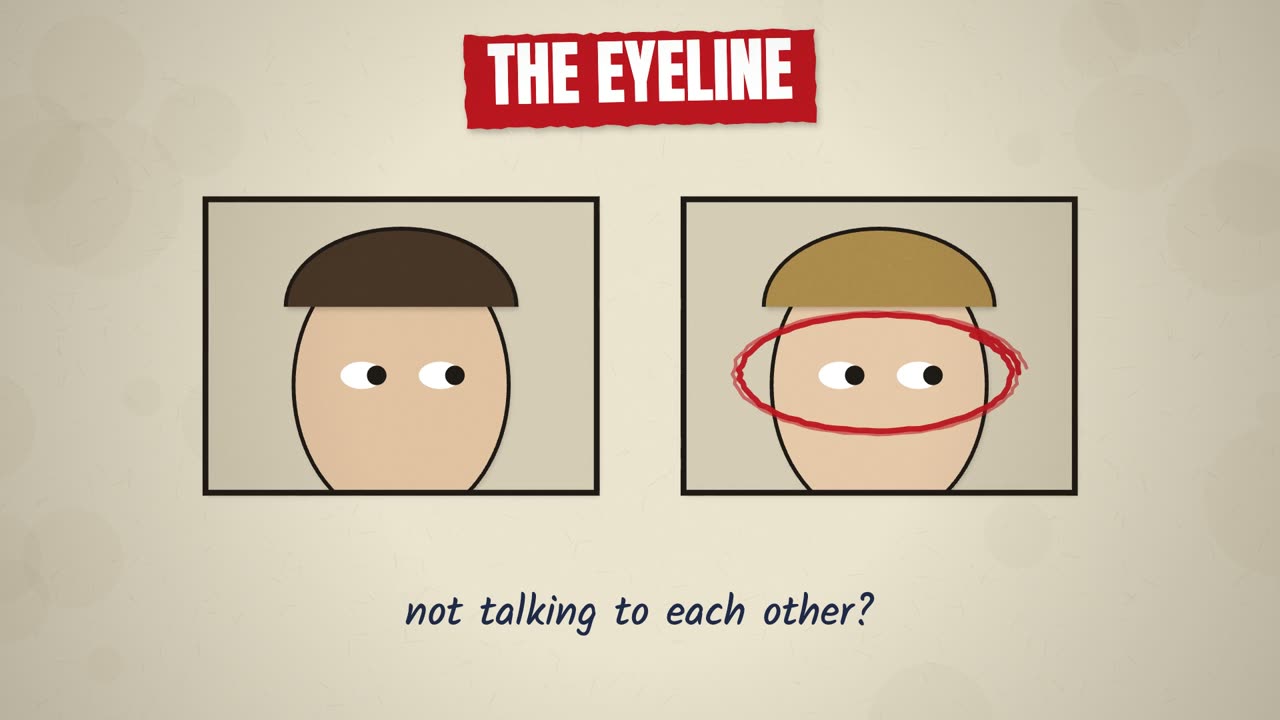
That last one is the eyeline, where an actor looks relative to the camera. If the eyelines don't match from one shot to the next, two people talking can look as if they aren't talking to each other at all [9][25].
3. The notes: every take, numbered and circled
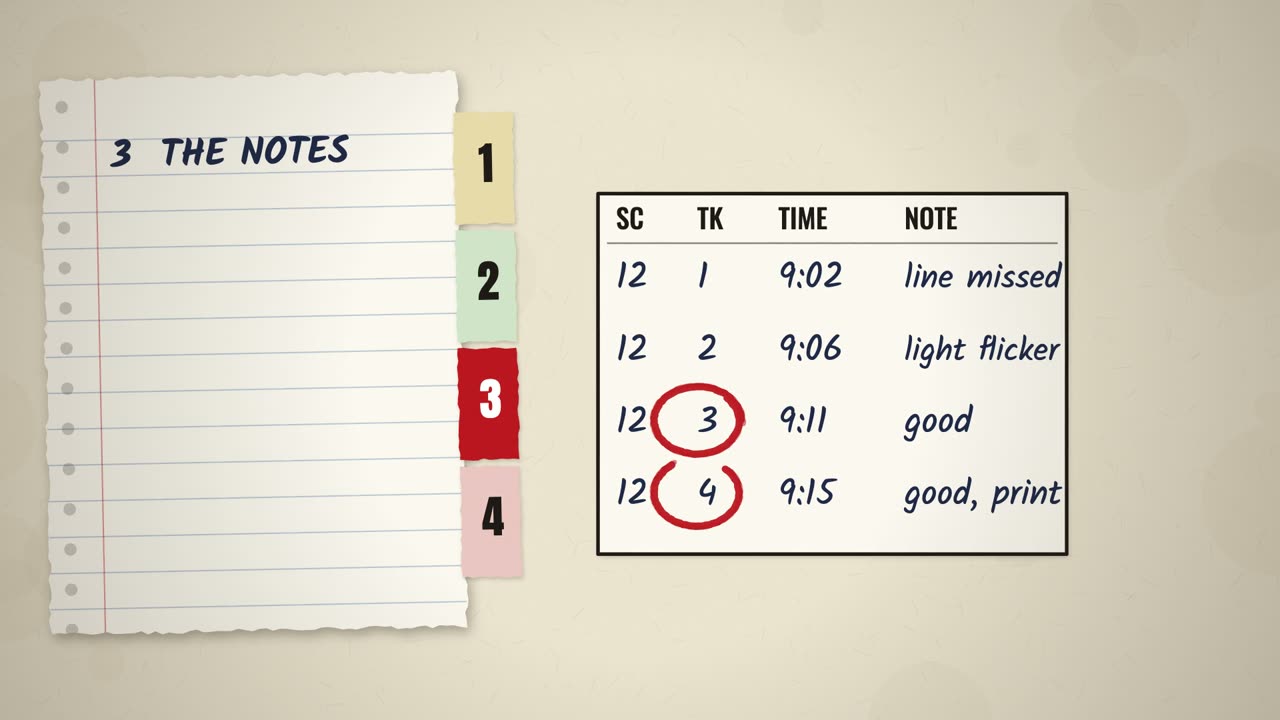
Every take gets a number, a time and a note. The notes record what went wrong, a missed line or a light that flickered, and what the director liked [7][12]. The director's favourites are circled, the "circle takes" [12]. The union job description says the script supervisor also furnishes camera and sound with the slate numbers and which takes are printed [7].
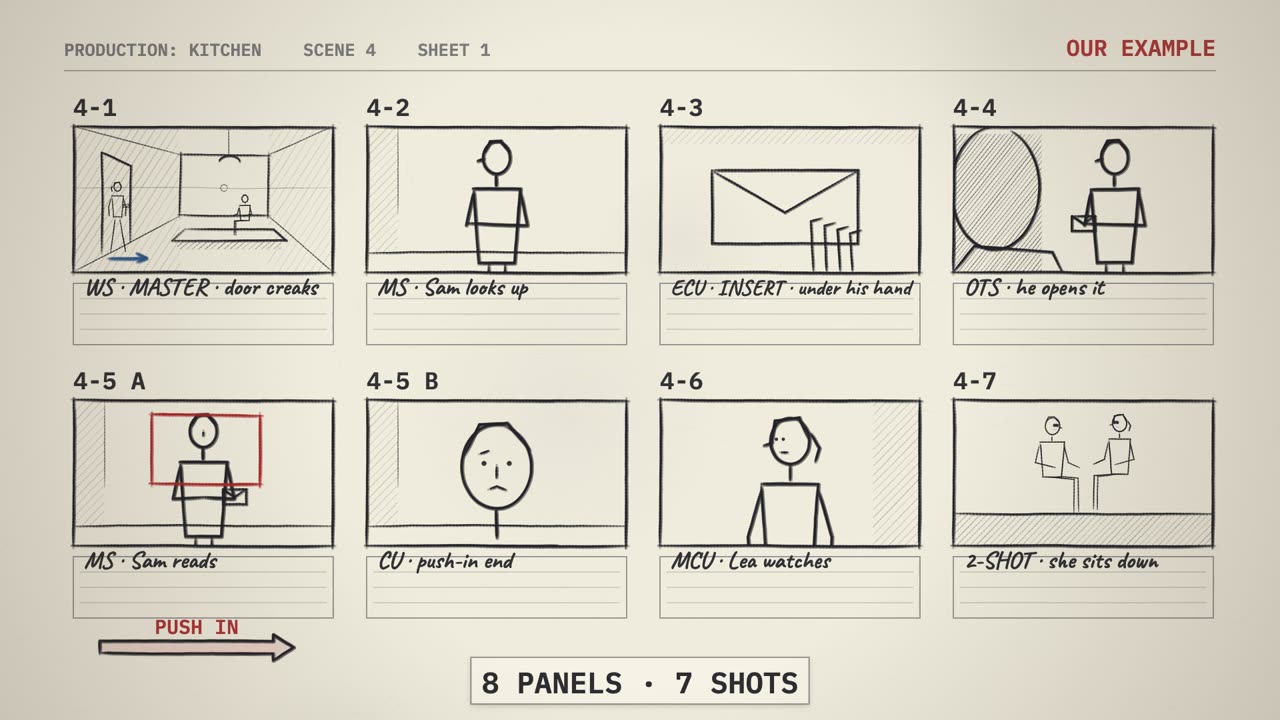
They also track coverage: whether every line and every action in the scene has been filmed. If a shot is missing, the script supervisor tells the director [7][9]. (Directors often plan that coverage before the shoot; here is how to make a storyboard that does it.) A classic moment between takes is the director leaning over to ask, did we get that line in the close-up [25]?
4. The lined script
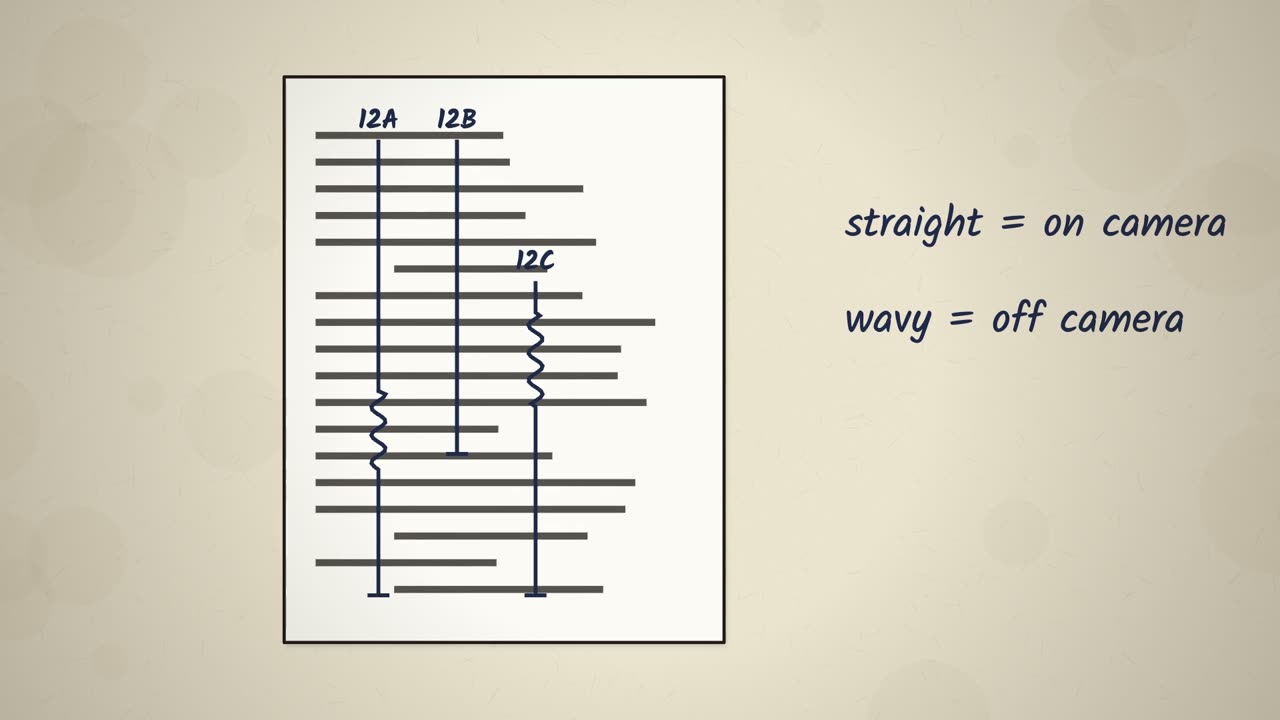
The fourth part is the lined script, sometimes called a marked-up script. On a copy of the script, the script supervisor draws a vertical line for each camera setup, meaning each camera position, down through the lines of dialogue that setup covers, labelled with its scene and setup number. The line is straight where the person speaking is on camera and wavy where they're off camera [8][24][25].
The point is speed. The editor can see at a glance which shots cover which lines, and anyone can see what's still missing [24][25].
After wrap: the editor's morning
When the crew goes home, the script supervisor often doesn't. Allen said you've normally got another hour or two after wrap [8].
Two things leave their desk. A daily report goes to the production office: the number of setups, the minutes of screen time, the scenes and pages shot, and running totals [7]. And the notes and the lined script go to the editor [7][8]. Allen put it simply: "these notes are given to the editor, that's who you're making them for." She handed them in the next day, so the editor had them when syncing up the rushes [8]. Today a script supervisor sums it up the same way: great notes save the editor time [12].
To be fair, not every editor leans on them equally. The script supervisor Kim Berner says she knows two editors who have basically stopped using script supervisor notes, because they feel they aren't getting information from them [15]. The notes are only worth what's in them.
Why the edit is the heart of the job
Here's the most common misunderstanding about script supervisors: that the job is mainly about spotting goofs in the background. The heart of it is the edit [25].
If a line was never covered, or two shots don't match, nobody may notice on set. It shows up in the edit, and by then the fix is a reshoot. The script supervisor Chelsea Zotta says the job exists partly "to prevent reshoots as much as possible", and she mentions working on scenes costing "around a hundred thousand dollars" [12]. That is one person's experience, not an industry average.
Neil Oseman described the other side. On his own short film, shot without a script supervisor, he found only in the edit that a key detail had been dropped, a character's whereabouts were no longer clear, and he had crossed the line [13].
So who stops movie mistakes?
Not one person. On a big production, costume, hair, make-up, props and camera all keep their own continuity notes, and the script supervisor cross-checks against them [14][25]. An error that reaches the screen has been missed by many people [14].
Which brings us back to the cup. HBO itself said it came from craft services [1]. When it reached the screen, it hadn't got past one person. It had got past a whole crew.
Angela Allen and Katharine Hepburn: the job under pressure
The best picture of what the job really asks comes from one story, told by the woman it happened to.
Angela Allen was born in London in 1929 [8][10]. By her account, she learned shorthand and typing and "literally went knocking on doors" until she got a trainee place in continuity, at about eighteen [9][10]. In Britain the job was called continuity then [9].
In 1951 she was the continuity person on The African Queen, directed by John Huston and starring Katharine Hepburn and Humphrey Bogart. The film was shot mainly on location in the Belgian Congo and Uganda; the unit lived in a camp at Biondo, near Stanleyville, and travelled to the Ruiki River. Most of the cast and crew were sick for much of the filming, with dysentery and malaria. Allen wasn't [18][8]. She believed she got the job partly because she was the youngest continuity person in the business and "the fittest to survive in the jungle". Huston was already in Africa and hired her, as she put it, sight unseen [9].
The moment, as she told it
Allen told this story in two interviews, two years apart; it isn't independently documented, so this is her account [9][10].
Huston wanted to pick up another close-up of something already shot. Allen said Hepburn would have to change what she was wearing first. In one telling it was her blouse, "or hat or something" [9]. Hepburn said no.
"I was only 22 and she was this big star," Allen said. "It was quite intimidating for me to say you're wrong and I'm right" [9]. There was nothing to check against: "we didn't have Polaroids or stills. It's what I've written down" [9].
Huston settled it. He trusted her, she said. In her telling, he said: "That's Angie's job, we will go with what she says" [10].
And then she waited. In one interview it was "till I got back to London"; in the other, "another six weeks" [9][10]. Either way, she found out weeks later. She was right [9][10].
That's the job in one scene: the notes were the only memory the set had, and the director trusted them.
Allen went on to work on more than a hundred films, fourteen of them with Huston [19][10]. Asked once whether she was a sort of on-set computer, she answered: "Sort of. A memory bank" [9]. Her description of the job hardly changed: you sit beside the director, and "you can't really leave the set" [9].
From script girl to continuity supervisor and script supervisor
Part of the reason so few people know this job is its name.
By 1919, a trade paper recorded a "continuity clerk" at the Douglas Fairbanks company in Hollywood, a man named Lou Howland [20]. By 1922 the phrase "script girl" was in print [21]. For most of its history the job was done overwhelmingly by women, and its names were feminised: continuity girl, script girl. They later gave way to continuity supervisor and script supervisor, the second more common in the US [16]. Scholars link that label to a lack of status, and the BFI says the work was historically "sidelined and diminished" [16][17].
A legend: the first script girl
You may read that the first script girl was Sarah Y. Mason. Variety said so in 1930, calling her "the first known holder of such a job" [22]. It's a nice story, and nobody can prove it. The claim has never been documented, and a man was already working as continuity clerk at the same Fairbanks company in 1919 [20][22]. Mason herself later became a screenwriter and shared the Academy Award for the screenplay of Little Women (1933) [26].
A name with dignity
In 1945 the American guild renamed itself, from the Script Clerks Guild to the Script Supervisors Guild, [23], a move the guild's history describes as "according that profession its proper dignity" [6]. The guild had been founded in 1937 and became IATSE Local 871 in 1958 [6].
In Britain, Allen said, the title script supervisor came much later. Her verdict on the change: "Identical job" [9].
Script supervisors today: notebooks, tablets and a warning
In the early days, the job was pen, paper and drawings, with no video playback [10][15]. Today many script supervisors work on a tablet or a laptop, with software made for the job [15][17].
In the 2023 roundtable, the script supervisor Jodi Domanic gave the warning every beginner should hear: "sometimes people think that if they learn the software then that makes them a script supervisor." They end up, she said, just note-takers [15].
The tool holds the notes. The person has to know what to watch.
Our app for script supervisors: Scripty
That's the honest way to think about our own app, Scripty. It's made by EgeTech, the studio behind this site and the Cheat the Shot channel, and it sponsored the video above. It's a script supervisor app for lining scripts, logging takes, continuity and editorial reports, on iPhone, iPad and Mac. It works offline, it's free to download, and your first project is free; after that it's a one-time purchase, with no subscription.
It won't make you a script supervisor. It just holds the notes. You don't need it for anything on this page: a pencil, a stopwatch and a copy of the script will do. Try it on the App Store: Scripty. More about Scripty: egetechnology.net/scripty.
The job, in one line
Seventeen million people, by HBO's count, saw that coffee cup [2]. Almost none of them noticed everything in that episode that did match: the lines, the hands, the eyelines, the takes. Somebody kept track of all of it. That's what a script supervisor does. Done right, it leaves nothing for you to notice.
Sources
- T. Maglio, "HBO Admits 'Latte' in Last Night's 'Game of Thrones' Was 'a Mistake'", TheWrap, 6 May 2019 (HBO's statement and "a craft services coffee cup").
- T. Maglio, "'Game of Thrones' Ratings: 'The Last of the Starks' Draws 17.2 Million Multiplatform Viewers", TheWrap, 7 May 2019. HBO's own figure; a lower live-only figure is reported elsewhere.
- HBO statement to ET Online, 6 May 2019; FOX 9, 7 May 2019 (the cup digitally edited out).
- LMU School of Film and Television, Student Production Handbook, "Script Supervisors" (2021, updated).
- Motion Picture Classic, c. 1924 (dated by a 1 April 1924 ownership statement on the same leaf), via the Media History Digital Library, lantern.mediahist.org, page motionpicturecla00brew_0793.
- IATSE Local 871 (Script Supervisors), "About Us" and "History". https://ialocal871.org
- IATSE Local 634, "Script Department Positions and Descriptions" (2025), https://iatselocal634.com; IATSE Local 856, "Continuity Job Descriptions 2024", https://iatse856.com.
- Angela Allen, BECTU History Project interview 168 (1990). https://historyproject.org.uk/node/1334
- J. Rees, "theartsdesk Q&A: Script Supervisor Angela Allen", The Arts Desk, 5 March 2011.
- D. A. Ellis, "The Continuity Girls: Angela Allen and Pam Mann-Francis", Film International, 3 June 2013. https://filmint.nu
- Walter Murch, Web of Stories interview clips 195 and 197. https://www.webofstories.com
- G. Smith, "Production Jobs Deep Dive: Script Supervisor", Missouri Film Office, 3 December 2024 (script supervisor Chelsea Zotta quoted).
- N. Oseman, "The Value of a Full Crew", 2012. https://neiloseman.com
- D. P. Fisher, "How script supervisors keep film continuity", The Conversation, 2 February 2020.
- M. Williams (ed.), "'A Film-maker Not A Note-Taker': A Roundtable Discussion on the Craft of Script Supervision", Open Screens 7:1 (2024), CC BY 4.0, recorded fall 2023. https://doi.org/10.16995/os.18267
- M. Williams, "The Continuity Girl: Ice in the Middle of Fire", Journal of British Cinema and Television 10:3 (2013). https://doi.org/10.3366/jbctv.2013.0160
- BFI, "Inside the Archive #10" (Melanie Williams). https://www.bfi.org.uk
- AFI Catalog, The African Queen (1951). https://catalog.afi.com/Catalog/moviedetails/50007
- Il Cinema Ritrovato, "Angela Allen: The Woman Who Saw Everything". https://www.ilcinemaritrovato.it
- Camera! (Los Angeles), 1919–20, via the Media History Digital Library, page camera1919losa_0143.
- Exhibitors Trade Review 12:16 (1922), p. 1046, via the Media History Digital Library, page exhibitorstr00newy_0162. The earliest use we found, not necessarily the earliest.
- "The Important Script Girl", Variety, 26 March 1930, p. 29, via the Media History Digital Library, page variety98-1930-03_0248.
- Daily Variety, 1945 (about 16 May), via the Media History Digital Library, page dv-1945-apr-jun_0414.
- "Marking the Shooting Script", course handout, Routledge companion file for ISBN 9780415822589.
- Professional review of the craft points on this page (shooting out of order, timing, story days, on-set continuity, eyelines, take notes, coverage, the lined script, wrap paperwork, the edit, shared continuity, today's tools): Onur Thornfield, cinematographer, 2026. Conventions differ between productions and countries; these are the common ones.
- V. Sturtevant, "Sarah Y. Mason", Women Film Pioneers Project, Columbia University Libraries. https://wfpp.columbia.edu