The Dark Knight Explained: Why the Joker Was Never Really After Batman
The Dark Knight explained: who appointed the Batman, why the Joker's real target was Harvey Dent and the law, what the ferry scene tests, and the final lie.

The Dark Knight (2008), explained in one line: it keeps asking what happens when a city hands its safety to a man nobody appointed. Here is our reading in short. Batman fights crime with fear, outside the law. The Joker arrives as the answer to him, not as a villain from nowhere, and his real target is not Batman but Harvey Dent, the face of the law. The ferry scene tests whether ordinary people will turn on each other. And the film ends on a lie told to save the law's good name. Where we say "we read" or "our reading", that is our interpretation, not something the filmmakers have said.
Spoilers ahead for The Dark Knight and Batman Begins.
A president and a Batman film
In 2014, after ISIS took Mosul, President Obama's view of the group changed, and his advisers recall that he later explained it with a scene from The Dark Knight. [1] The mob meeting, about twenty minutes in: the gang leaders of Gotham at one table. As Jeffrey Goldberg reported his words in The Atlantic: "They were thugs, but there was a kind of order. Everyone had his turf. And then the Joker comes in and lights the whole city on fire. ISIL is the Joker." [1] (ISIL is another name for ISIS.)
You could smile at that. But it raises a question we have chewed on for a long time: what separates a good film from a classic? Our test, and it is only ours: a classic carries a philosophy. Not a message on a poster, but an argument you can still have with it years later. By that test, The Dark Knight is a classic, and it is darker than the president's comparison.
How Christopher Nolan got Batman
In January 2003, Warner Bros. gave Batman to Christopher Nolan, the director of Memento, as Variety reported. "He's not a magical character," Nolan said. [4] The last live-action Batman before his, Batman & Robin (1997), disappointed so many fans that its director, Joel Schumacher, later apologised to them. [5]
How the offer reached Nolan is a story, not a record; no source confirms it. (Film history is full of stories like this; we hold a bigger one up to the record in Jodorowsky's Dune, the film never made.) The story goes that his wife and producing partner, Emma Thomas, passed it on almost as a joke over breakfast, and he surprised her by saying yes. What is certain is that she produced all three films. [3]
The writers did their homework. Jonathan Nolan, Christopher's brother, went back to the Joker's first appearance in 1940; David S. Goyer has said they pulled from The Killing Joke, some of The Long Halloween and some Frank Miller. [6] And there is one more influence to keep in your pocket: Jorge Luis Borges, the Argentine writer of labyrinths and mirrors. Asked by the BBC which book he would take to a desert island, Nolan chose Borges's collected writings: "In a way, all stories are contained within his stories." [7] Borges comes back at the end.
Batman Begins: two kinds of justice
The argument starts in the film before. In Batman Begins (2005), Bruce Wayne learns that Joe Chill, who killed his parents fourteen years earlier, shared a cell with the mob boss Carmine Falcone and will testify in exchange for early parole. Bruce brings a gun to the hearing. He never uses it: someone else shoots Chill first. [3]
His oldest friend, Rachel, gives him the speech we think the whole trilogy rests on: "You're not talking about justice. You're talking about revenge." Justice is about harmony; revenge is about making yourself feel better. Falcone is "creating new Joe Chills every day." [3] Then Falcone himself tells Bruce how the city works: "That's the power of fear." [3]
Abroad, Bruce meets a teacher who turns out to be Ra's al Ghul. "Crime cannot be tolerated," he says; even the death of Bruce's parents was his father's fault, because he "failed to act." But Bruce refuses to execute a prisoner: "I'm no executioner." [3]
Philosophers have names for these two instincts. Retributive justice holds that serious crimes deserve a punishment in proportion, and no more. [11] Restorative justice starts elsewhere: a crime harms victims and a community, and they take part in putting things right. [12] Rachel isn't running a restorative programme (the frame is ours), but she points at causes, while Ra's points at the guilty. Then Ra's breaks retribution's own rule of proportion: he wants to burn the whole city. "A purging fire is inevitable and natural." [3]
Our reading: Bruce takes the target from Rachel, the causes of crime, and the weapon from Falcone, fear. Put together, that is Batman. And it works well enough that by the second film he has partners. Which leaves a question nobody in Gotham has asked yet.
Who appointed the Batman?
The Dark Knight opened in US cinemas on 18 July 2008. [19] Three men are going after the mob: Jim Gordon, a police lieutenant; Harvey Dent, the new district attorney; and the Batman, who has no title at all. [2]
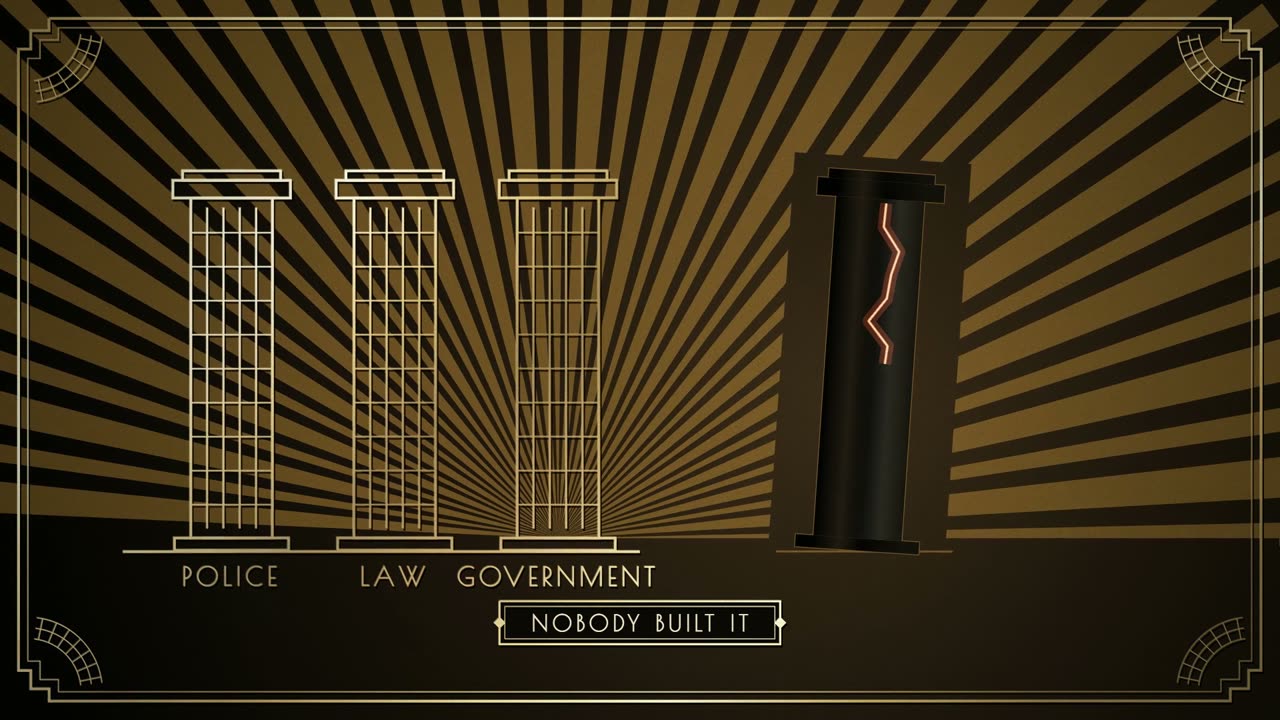
Here is our image for it. Gordon is the police, Dent the law in court, the mayor the elected government. Batman is a fourth pillar beside the other three. Nobody built it. Nobody voted for it.
The film says it out loud, over dinner. A guest, Natascha: "Gotham needs heroes like you, elected officials, not a man who thinks he's above the law." Bruce, of all people, asks: "Who appointed the Batman?" Dent: "We did. All of us who stood by and let scum take control of our city." When Natascha says "this is a democracy", Dent reaches for Rome: when enemies were at the gates, the Romans suspended democracy and appointed one man to protect the city. [2]
Dent has the office right. Cicero describes it: in a serious war or civil unrest, one man held the power of both consuls, for no more than six months. [9] Rachel finishes the story: the last man appointed was Caesar, and he never gave up his power. Plutarch says the Romans made Caesar dictator for life: "This was confessedly a tyranny." [10]
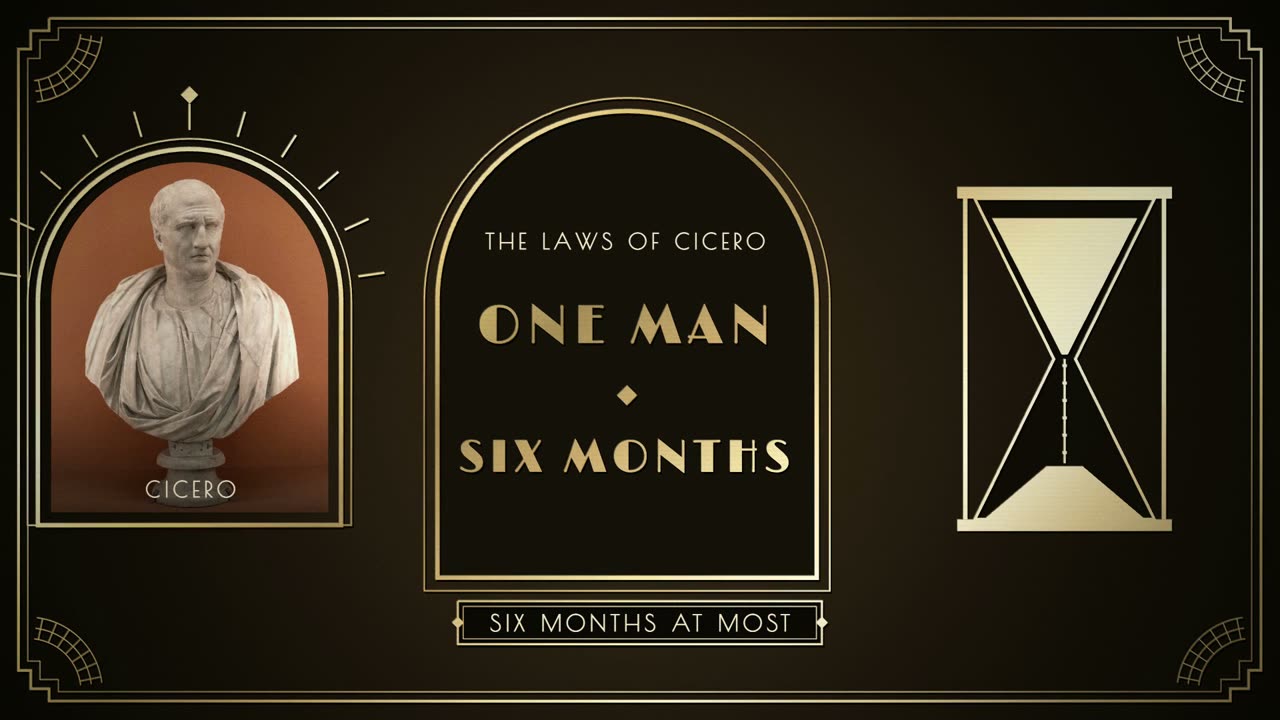
Then Dent says the line everyone quotes: "You either die a hero, or you live long enough to see yourself become the villain." [2] The film remembers it.
The Joker as an answer
Back to the president's scene. Into the mob's meeting walks the Joker, offering to kill the Batman for half. "If you're good at something, never do it for free." [2] Notice what they are paying for: not bad business, but Batman. We read the Joker not as an origin story but as a reaction, and the film never gives him a past.
Alfred warns Bruce with a story about a bandit north of Rangoon who threw the stolen stones away: "Some men just want to watch the world burn." [2] In the interrogation room, the Joker says it himself: "I don't want to kill you. What would I do without you?... You complete me." [2] Batman acts; the Joker reacts.
Instead of a past, he tells stories. "You know how I got these scars?" To the gang boss Gambol, it is a cruel father; to Rachel, a wife who gambles and gets in deep with the sharks. [2] It is a reading, not something the film states, but each story seems fitted to its listener: a gang boss whose grandma the Joker had just mocked, and a woman between two men who gamble with their lives. He doesn't tell you who he is. He shows you who you are. (A character with no past and a mask for every audience is an old idea on the stage; see the stock types of the commedia dell'arte.)
What was the Joker's plan? His real target was Harvey Dent
Everyone assumes the Joker is after Batman. Look at his list instead. On a playing card marked with their DNA he names Judge Surrillo, Harvey Dent and Commissioner Loeb; then the mayor, in the obituaries. [2] The judge dies when her car explodes, and at the funeral Gordon takes a bullet and is believed dead. [2]
A judge, a commissioner, a mayor, a district attorney: not one of them wears a cape. Here is how we read it. Batman's right to exist is already up for debate. The law's isn't. That is what is worth breaking.
The Joker takes Dent and Rachel and gives Batman two addresses. Batman goes for Rachel and finds Dent. Rachel dies; Dent survives with half his face burned, and his father's lucky coin now has a scarred side. [2] In the hospital the Joker tells him: "I'm an agent of chaos. And you know the thing about chaos? It's fair." [2] This is where the Joker wins his argument with the law. He doesn't kill Harvey Dent. He converts him.
Every phone in Gotham, and the Patriot Act
With the law's own face broken, the protector starts listening to everyone. Batman turns Lucius Fox's sonar concept into a machine that uses every phone in the city. Fox: "This is wrong." Spying on thirty million people isn't part of his job description. "Consider this my resignation." [2]
Within two weeks of the release, people argued about what it meant. Andrew Klavan wrote in the Wall Street Journal, as quoted by Salon: "The Dark Knight, then, is a conservative movie about the war on terror." [14] The ACLU's blog answered him: "caped vigilantism is not the answer to the so-called 'war on terror'." [15] Years later, co-writer Jonathan Nolan remembered that "everyone on the political spectrum had decided [it] was an apologia for either their side or the other side." [16]
Now the part that is not a reading. On 26 October 2001, six weeks after September 11, the USA PATRIOT Act became law, to give investigators new tools against terrorism. [17] In 2015, a federal appeals court ruled that the government's bulk collection of Americans' phone records went beyond what that law allowed. [18]
We are not saying the film is about that programme; it came out seven years before the ruling. But it asks the same question and answers it its own way. The machine works, and at the end Fox types his name and it destroys itself. One use, and gone. That is as close as the film comes to a position.
The Dark Knight ferry scene and the prisoner's dilemma
The Joker's last test is for the people. Two ferries leave Gotham at night, one with ordinary passengers, one with prisoners. His voice comes over the speakers: "Each of you has a remote to blow up the other boat. At midnight I blow you all up. If however one of you presses the button, I'll let that boat live." [2]
Game theorists know this game's cousin, the prisoner's dilemma: whatever the other player does, you do better by betraying them, so both betray and both end up worse off than if they had trusted each other. [13]
The ferry game is not the textbook version. If nobody presses, everyone dies at midnight. If you press first, your boat lives whatever the other does. So pressing is the dominant move, and the one box nobody should end up in is the one where both boats wait.
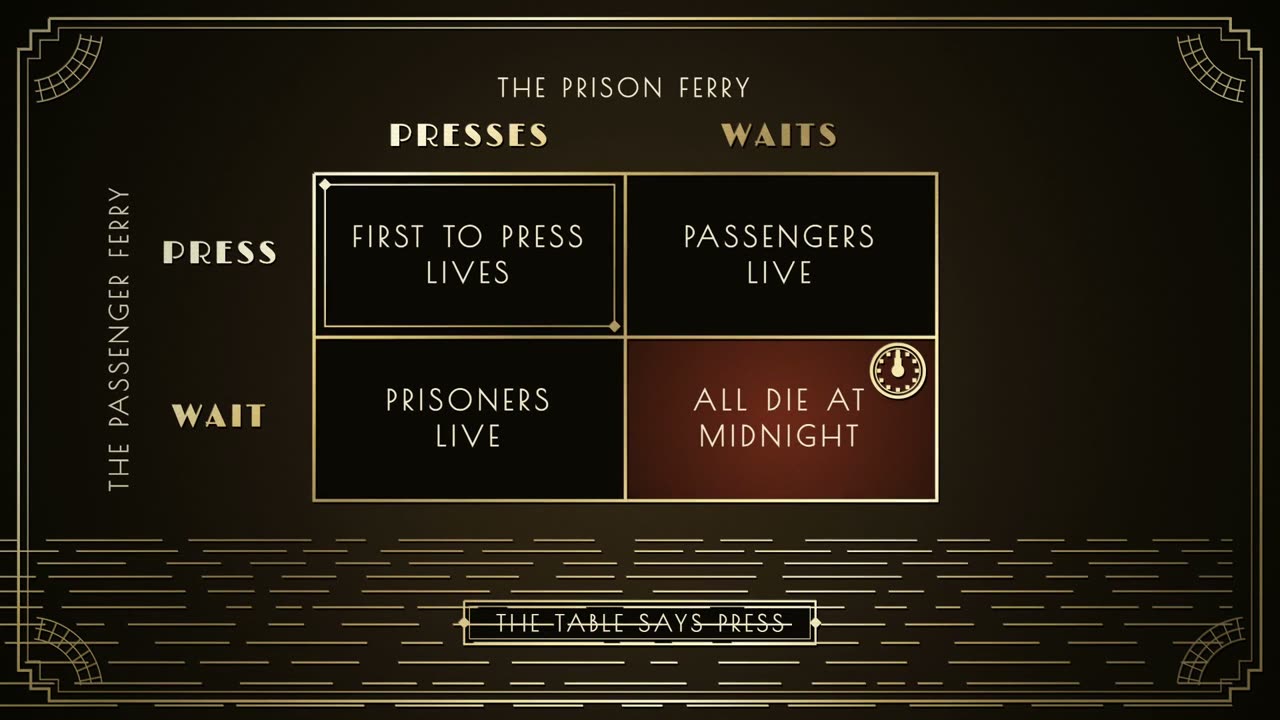
On the passenger ferry they vote (the film gives no count we could confirm, so we give none). A businessman takes the remote: "Those men on that boat, they made their choices." Then he can't press it. [2] On the prison ferry, a prisoner tells the warden: "You don't want to die, but you don't know how to take a life. Give it to me." The warden hands it over, and the prisoner throws it out of the window. [2]
Game theory says press. Nobody pressed. Not because the math was wrong, but because people are not the math. The Joker had told Batman that "when the chips are down, these civilized people, they'll eat each other." [2] Our reading: the ferries are the film's answer to him. When Batman says the city is full of people ready to believe in good, the Joker replies: "Till their spirit breaks completely. Until they get a good look at the real Harvey Dent." [2] So the city passed the test. Why does it then have to be lied to?
The Dark Knight ending explained: why Batman takes the blame
By the film's own tally, five are dead, two of them cops. Dent holds Gordon's family at gunpoint; in the struggle he falls and dies. [2] Did Batman break his one rule? The film shows a fall, not a choice. We leave that one with you.
Batman offers to carry it all: "I killed those people... I'm whatever Gotham needs me to be." [2] Dent's line from the dinner comes true, for Batman instead. The city will remember Dent as a hero, and the Batman will be hunted. Gordon tells his son: "He's the hero Gotham deserves, but not the one it needs right now." [2]
Now the Borges in your pocket. His 1944 story "Theme of the Traitor and the Hero" is set in Ireland, "let us say 1824". A man named Ryan researches his great-grandfather, Fergus Kilpatrick, a murdered hero of the cause. The truth: Kilpatrick's oldest comrade had proved that Kilpatrick himself was the traitor in their conspiracy. Kilpatrick signed his own death sentence, asking only that his punishment not harm the country. The comrade, a translator of Shakespeare into Gaelic, was named James Alexander Nolan. Yes, Nolan. [8]
Nolan staged the execution as a murder by an unknown assassin, borrowing scenes from Julius Caesar and Macbeth, with hundreds of people as actors. Kilpatrick was shot in a theatre box. A traitor, made a hero on purpose. Ryan understands, keeps silent, and writes a book to the hero's glory. That too, Borges adds, was perhaps foreseen. [8]
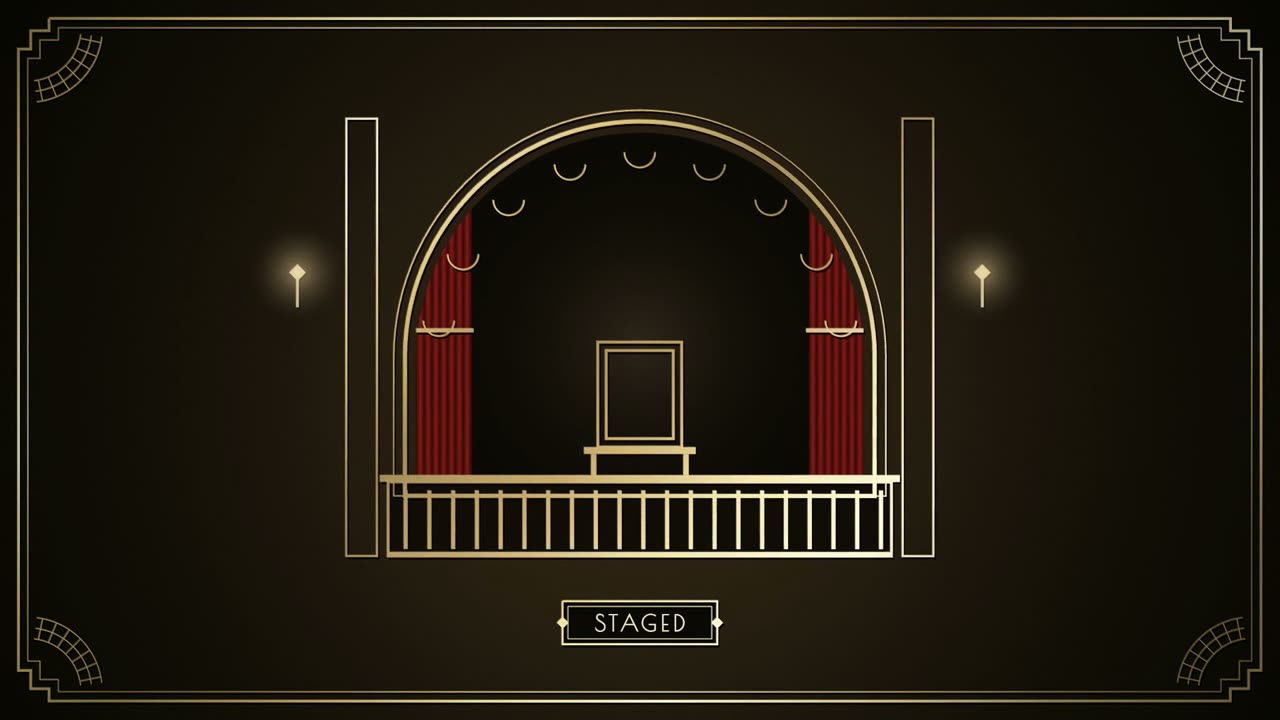
We are not saying the film was built on that story; nobody has shown it was. But read the two side by side. A man is turned into a hero by a lie, staged for the good of the country, and the one who knows keeps quiet. The lie saves the hero's name.
Did Gotham create its own villain?
Put the whole film in one breath. Crime the law cannot reach. A man who steps outside the law to reach it. An enemy who answers by attacking the law itself. A machine that listens to everyone. And at the end, a lie to hold the city together.
The president was right about the Joker. But the film goes one step further than his comparison: its Joker does not come out of nowhere. He comes as an answer. That, to us, is why The Dark Knight is a classic: not the stunts, not even the performance everyone remembers, but an argument you can still have with it. As we read the film, Gotham made its own villain: the city let the Batman in, the Joker came as his answer, and the peace that follows rests on a lie.
Sources
- Jeffrey Goldberg, "The Obama Doctrine", The Atlantic, April 2016 issue (read in the Wayback Machine copy of 20 March 2016). Also reported by the Times of Israel and the Christian Post, March 2016.
- The Dark Knight (2008), Warner Bros.; screenplay by Jonathan Nolan and Christopher Nolan, story by Christopher Nolan and David S. Goyer. Quotes follow the film's spoken wording; shooting script checked at https://assets.scriptslug.com/live/pdf/scripts/the-dark-knight-2008.pdf
- Batman Begins (2005), Warner Bros.; quotes from the film's spoken wording. Emma Thomas's producing credits: the credits of all three films.
- ICv2, "Memento Helmer to Direct Batman", 27 January 2003 (quoting Variety).
- The Playlist, 14 June 2017 (quoting Joel Schumacher's interview with Vice).
- Batman on Film, interview with Jonathan Nolan and David S. Goyer, 2 July 2008; interview with Emma Thomas, 1 July 2008.
- Far Out Magazine, on Christopher Nolan's BBC desert-island choice of Borges (quoting the BBC interview and The New York Times, 2010).
- Jorge Luis Borges, "Tema del traidor y del héroe" ("Theme of the Traitor and the Hero"), 1944, in Ficciones (Spanish original).
- Cicero, De Legibus 3.9 (Latin text, The Latin Library).
- Plutarch, Life of Caesar 57 (Loeb translation, LacusCurtius).
- Alec Walen, "Retributive Justice", Stanford Encyclopedia of Philosophy (revised 31 July 2020).
- UNODC, Handbook on Restorative Justice Programmes, 2nd edition, Vienna 2020.
- "Prisoner's Dilemma", Stanford Encyclopedia of Philosophy (revised 24 October 2025).
- Salon, 25 July 2008, quoting Andrew Klavan, "What Bush and Batman Have in Common", The Wall Street Journal, 25 July 2008.
- Allison Walker, "Holy Bill of Rights, Batman!", ACLU blog, 29 July 2008.
- Film Stories, 8 April 2024, quoting Jonathan Nolan on the Happy Sad Confused podcast.
- USA PATRIOT Act, Public Law 107-56, 26 October 2001 (GovInfo).
- ACLU v. Clapper, 785 F.3d 787 (2d Cir., decided 7 May 2015).
- The Numbers, The Dark Knight release (US wide release, 18 July 2008).