The Lake Nyos Disaster, 1986: What Came Out of the Lake, and Why No Camera Saw It
The Lake Nyos disaster of 1986: carbon dioxide from a lake in Cameroon killed at least 1,700 people in one night. What happened, the cause, and the lake today.

On the night of 21 August 1986, a cloud of carbon dioxide came out of Lake Nyos, a crater lake in northwest Cameroon, and killed at least 1,700 people in the valleys below. This was the Lake Nyos disaster. It was not a volcanic eruption and not an explosion of fire. The lake had been holding the gas in its deep, cold bottom water, and it let it all out at once. The gas was heavier than air, so it flowed downhill and reached people up to about 10 kilometres away. [1]
And almost nobody saw it happen. There was no smoke, no fire and no wreckage. The plants around people's homes were left almost untouched. [1] That is the strange heart of this story, and the question our video asks: how do you show a killer that no camera ever recorded?
The night of 21 August 1986
Lake Nyos is small: about 1.9 kilometres long and 1.2 kilometres wide. But it is deep, 208 metres at its flat bottom. [1] About 2 kilometres north of it lay the village of Lower Nyos. According to a geologist who mapped the area, about 1,200 people lived there, and 21 August had been market day. [2]
At about half past nine that night, people near the lake heard rumbling. It went on for perhaps 15 or 20 seconds, and it brought them out of their homes. One observer heard bubbling, then saw "a white cloud rise from the lake and a large water surge". He is the only person in the scientists' first paper who saw the cloud itself. [1]
What came next, nobody saw.
How the gas reached the villages
Whatever came out of the lake did not rise and drift away. Carbon dioxide is denser than air. According to the 1987 study in Science, the cloud first filled the crater basin to about 100 metres above its rim. Then it spilled over and ran down the low valleys, holding together as it went. [1] The villages hit hardest were Lower Nyos, Cha and Subum; Subum lies about 10 kilometres from Lower Nyos, down the valley. [2] By the first scientific count, the gas killed people up to about 10 kilometres from the lake. [1, 2]
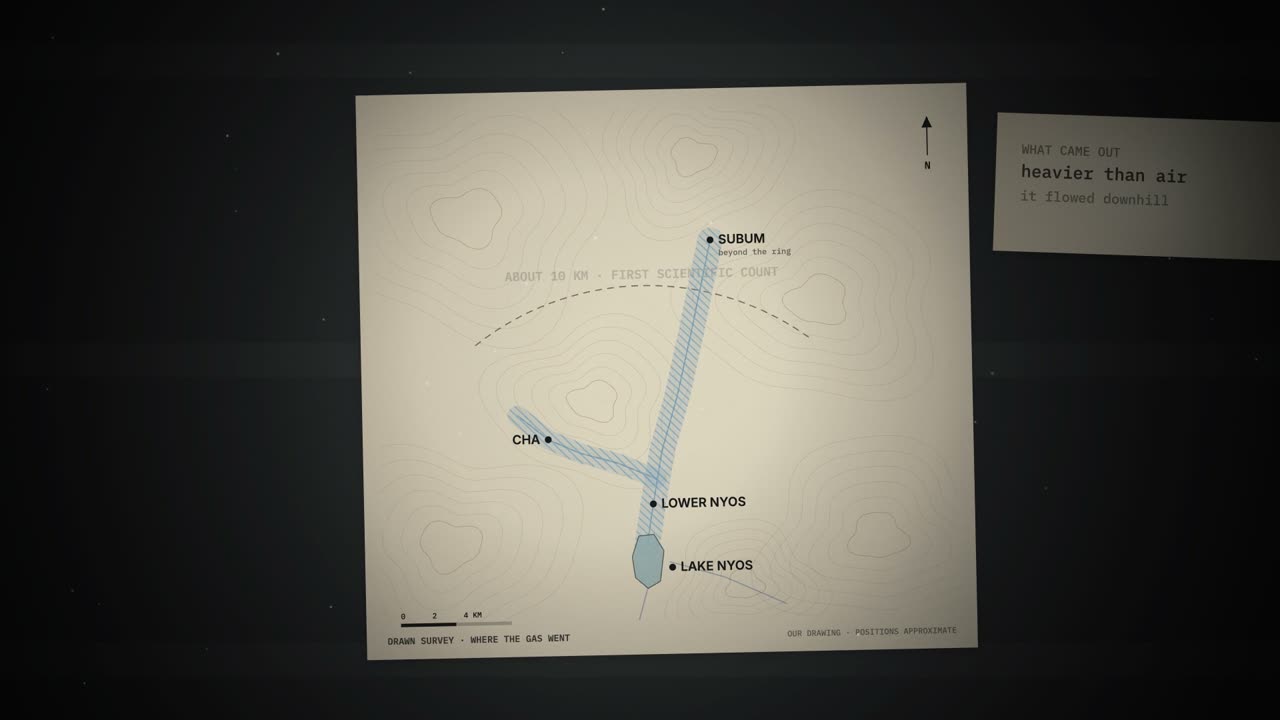
How fast it moved is not known. The 1987 paper says the speed could not be determined, and the figures you may see online have no firm source, so we give none. Later popular accounts also put the reach at 23 to 26 kilometres; the first scientific count says up to about 10. [1, 2]
What survivors reported
Near the lake, survivors noticed no unusual smell. Farther out, people woke to the smell of rotten eggs or gunpowder. Many felt warm, then lost consciousness fast. [1]
But there was no sulphur gas to smell. The 1987 paper explains that high levels of carbon dioxide irritate the nose and produce a sensation "reminiscent of gunpowder or rotten eggs". The scientists called it an olfactory hallucination: people exposed to the gas report the smell of sulphur when none is there. [1] Even their own senses were misleading them.
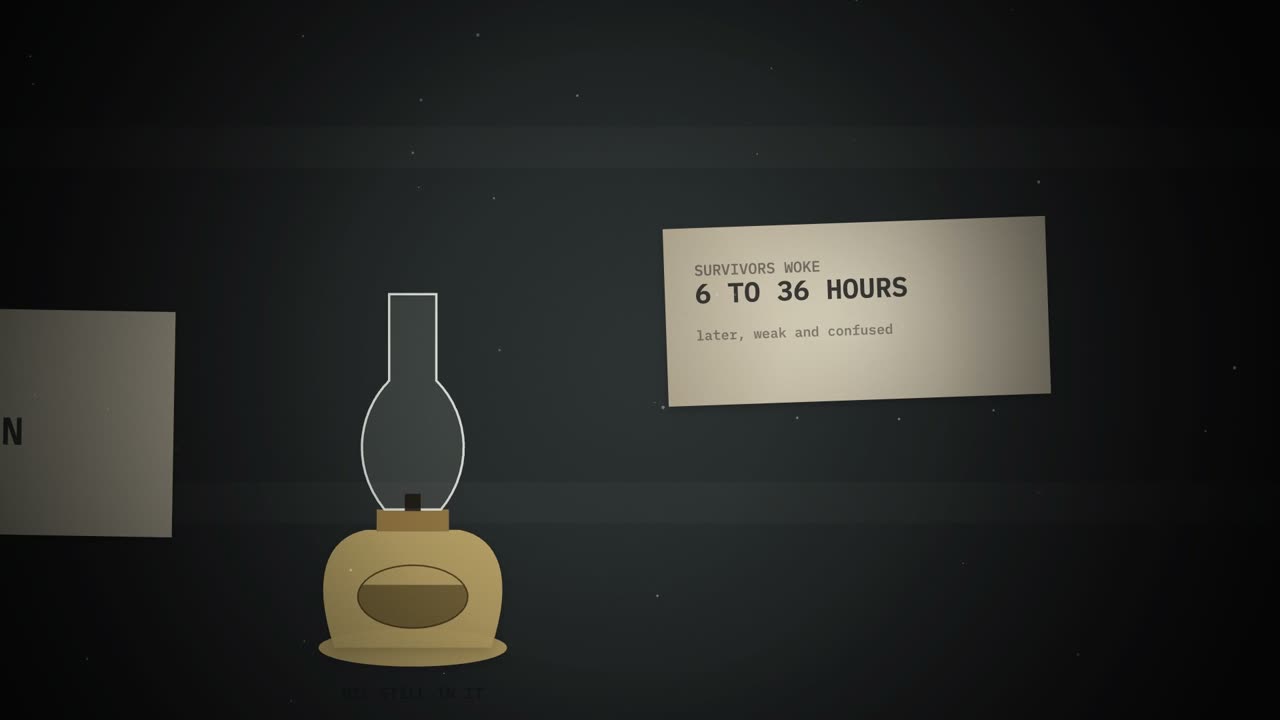
Survivors woke anywhere from 6 to 36 hours later. Many found their oil lamps had gone out, though there was still oil in them. Their animals were dead, and so were members of their families. [1] In Lower Nyos, by the same geologist's account, only four to six of those 1,200 people survived. [2]
The gas killed about 1,700 people and 3,000 cattle. [1] "At least 1,700" is the scientists' figure. A count of 1,746 is the one most often repeated; we have not traced where it comes from. [1, 9, 10]
Three days before the world knew
On 22 August, people from the surrounding area began burying their dead. For at least 48 hours, nobody saw a bird, an insect or a small mammal. [1]
The outside world heard only on the morning of 24 August, when two Swiss missionary helicopter pilots flew in. They reported that the victims seemed to have "died in their tracks". The scientists later checked that account by studying the photographs and film taken after the disaster. [1] Here, pictures were not decoration. They were evidence, much as Muybridge's photographs of a galloping horse had been a century earlier.
What the lake and the shore recorded
The American scientific team began its field work on 27 August. [1] The first thing anyone could see was the lake itself. Its normal clear blue had turned a rusty red: iron settling out of the water near the surface. Below 10 metres, the water was still clear. [1, 2]
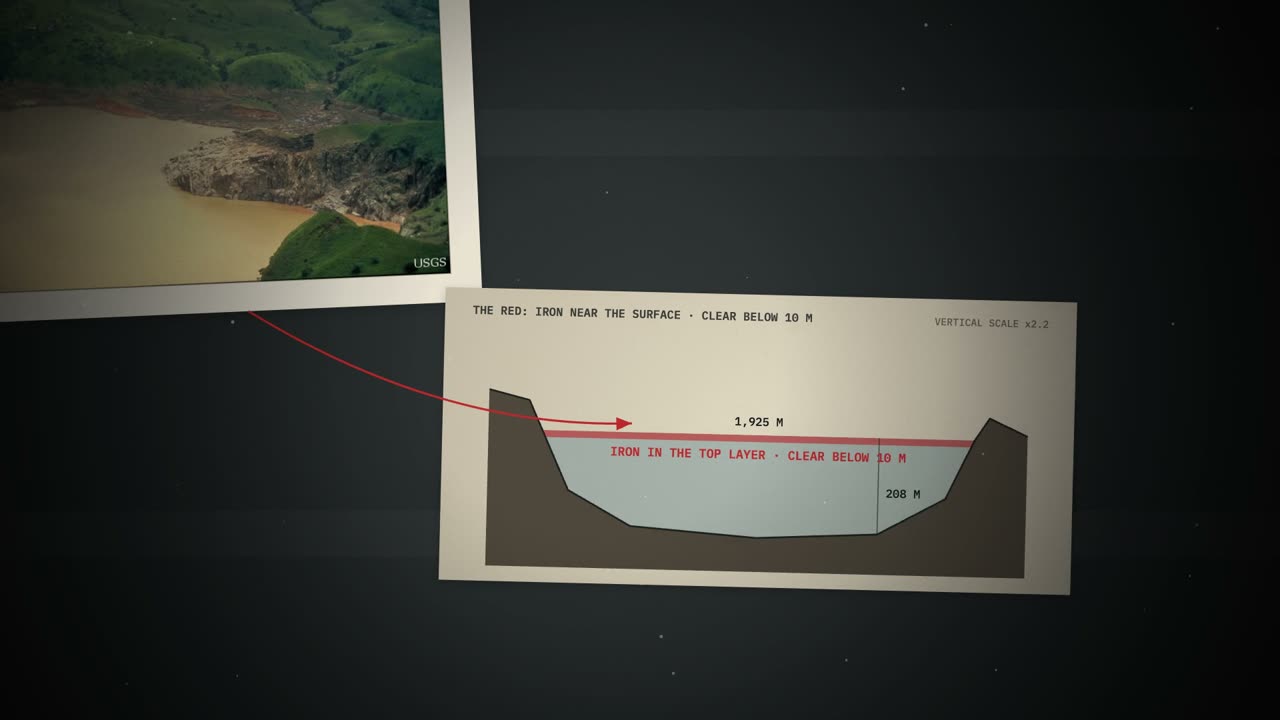
The shore kept the rest of the record. A surge of water had washed about 25 metres up the southern shore. A fountain of water or froth had splashed over a rock promontory about 80 metres high. And the whole lake had dropped about 110 centimetres. [1] By the scientists' estimate, the lake could have released about 1.2 cubic kilometres of carbon dioxide. [1]
The geologist Jack (John P.) Lockwood, of the U.S. Geological Survey, photographed the crater that August, and one of the cattle that died; both photos are now in the public domain. [1, 11] The photographer Eric Bouvet's series from Nyos won second prize in the Nature category of World Press Photo 1987. [12]
Yet every one of those pictures shows what the gas left behind. None of them shows the gas. Colour and colour-infrared photographs of the land around the lake showed no plant damage from it at all. [1]
The filmmaker who named the gas
One of the people with an answer was a filmmaker as well as a volcanologist: Haroun Tazieff (1914 to 1998). For years he paid for his own research with his films, books and lectures; his first feature, Les Rendez-vous du diable, from the late 1950s, was an international success. [3] His film Le Volcan interdit (1966), about the volcano Nyiragongo, was nominated for the Academy Award for Best Documentary Feature at the 39th Academy Awards. [3, 6] Yet to many academics, as his colleague Jacques Varet later wrote, he was "not a researcher, nor even a geologist, but an explorer, an adventurer, or a filmmaker". [3]
He had left the French government, where he had been in charge of major risks, about four months before Nyos. [4] According to the writer Frank Westerman, on Monday 25 August 1986 Tazieff told the French news agency AFP that the toxic gas was carbon dioxide, heavier than air and flowing along the ground. Westerman writes that Tazieff had once been "literally knocked out" by such a wave of it in Congo. [4]
He was right about the gas. The argument was about where it came from.
What caused the Lake Nyos disaster: volcano or lake?
Tazieff went to Cameroon on a field mission that year. [3] He argued for a gas eruption from a vent under the lake, what geologists call a phreatic eruption, like the one at Dieng in Java in 1979, where 147 people died. He set out his case in a 1989 paper. [2, 3]
The American team said no. Their 1987 paper found "no significant, direct volcanic activity". Carbon dioxide from deep magmatic sources had seeped into the lake and was stored in its cold bottom layer, and it came out in one release. [1] The geologist who mapped the area recalls that the American scientists compared it to a shaken bottle of cola: take the cap off, and it all rushes out. [2] The 1987 paper says its data are "difficult to reconcile" with a fresh injection of lava or with gas from a phreatic explosion. [1]
The way we read it, the difference mattered. If a vent was to blame, there was nothing to drain. If the lake had stored the gas, it could store it again, and it had happened before: two years earlier, on 15 August 1984, a smaller gas release at Lake Monoun had killed 37 people. [1]
Here is the twist. Both sides agreed on the gas. The Americans' 1987 paper even cites a 1982 paper Tazieff had co-written about people killed by gas at Dieng, as proof that deadly carbon dioxide flows into low ground. [1, 3] What they fought over was the door it came out of.
The clash came to a head at a conference (in Yaoundé in March 1987, by one account), with Tazieff leading the French delegation and Lockwood, the USGS geologist, leading the American one. [2] Westerman's book Stikvallei tells that story. [4] The lake explanation became the consensus, and when Tazieff died in 1998, the French side lost its main advocate. [2]
What set it off is still unknown
We know what killed those people. We still do not know what set it off.
The 1987 paper listed candidates: an internal wave in the lake, a seismic shock, a landslide, a flood of water, "or nearly any disturbance". No earthquake was recorded. Large boulders still sat perched on high points around the lake, and in many homes household goods were still neatly stacked, so any local shock was negligible. A fresh landslide scar was found, but nobody could say when it fell. [1] In a 2002 BBC film, Killer Lakes, the scientists George Kling and Bill Evans are reported to suggest a rockslide as the trigger. [2] The paper's own words still stand: the trigger mechanism is unknown. [1]
Into that gap went rumours. Since 1986, some people have said it was a secret military test, by Israel, France or another Western power. There is no evidence for that. [10] It is easy to see why people reached for a culprit, though. Something had killed so many people in one night, and left nothing of itself you could photograph.
How you show a gas nobody filmed
This is where the story becomes a filmmaker's problem. What you need to show has no colour, and it was gone by morning. In our video we use four ways to show it, and every one of them comes straight from the record:
- Show what it does, not what it is. Tazieff lost the argument about the vent, but his picture of the gas was the right one: a heavy gas flowing along the ground. The 1987 paper describes the same thing, the cloud filling the crater and running down the valleys. [1, 4]
- Let the traces draw it. Nobody saw the 100-metre line above the rim; the scientists worked it out from where the cattle had died. The shore plants drew the height of the surge, and the lake sat 110 centimetres lower. [1]
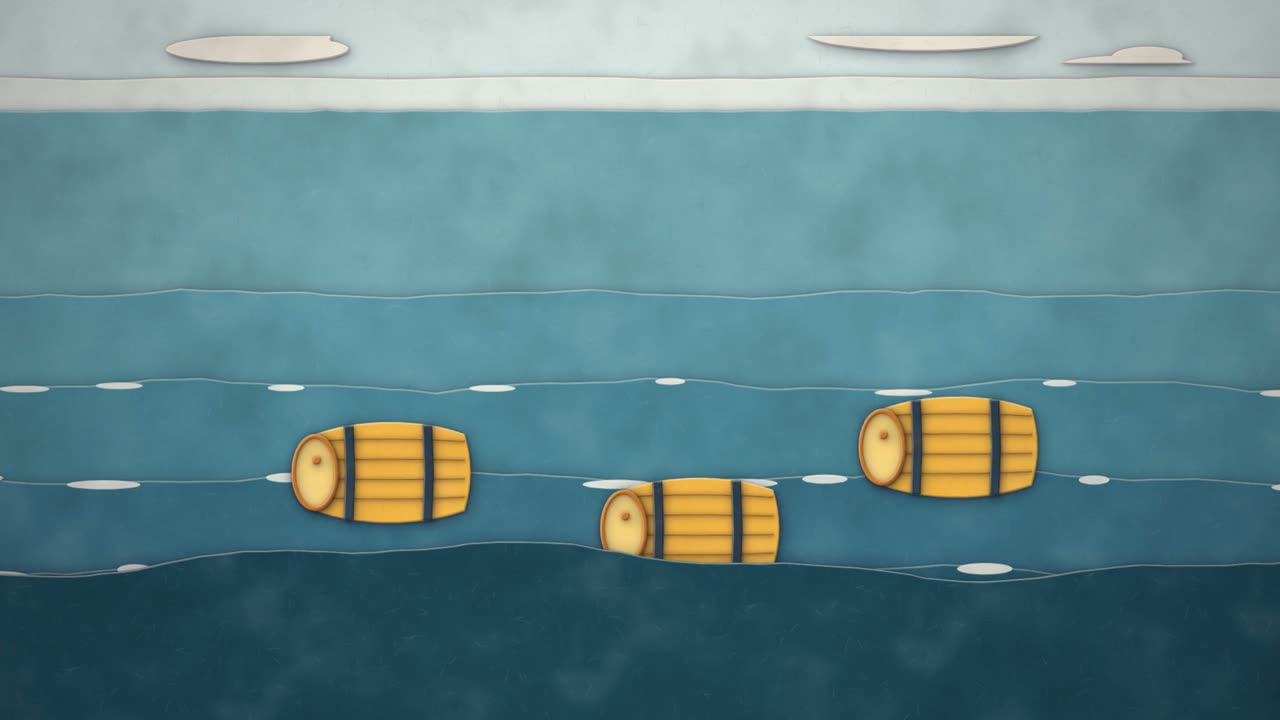
- Use absence. No birds or insects for two days. Lamps that went out with oil still in them. Boulders still balanced. When the thing itself cannot be filmed, what is missing becomes the shot. [1] It is the same trick Jaws used with its broken mechanical shark: show the barrels, not the animal.
- Draw the path. In 2002 NASA's Scientific Visualization Studio made "Lake Nyos Zoom-in", a zoom from space down to the lake, with Kling and Evans as scientists. [7] Later shows went bigger: a 2020 episode of Reactions on PBS called it an invisible tsunami. [8] But nobody ever filmed a wave. The honest picture is a line on a map.
Lake Nyos today: the degassing pipes
The remedy was proposed as early as 1987: pump the gas-rich deep water to the surface, under control. [1] In 2001 a joint American, French and Cameroonian effort installed the first permanent degassing pipe, about 200 metres long, reaching from the surface down into the deep water. It needs no pump. The gas itself lifts the water and throws up a fountain about 40 metres high, taller than a ten-storey building. Two more pipes followed in 2011 and 2012. [2]
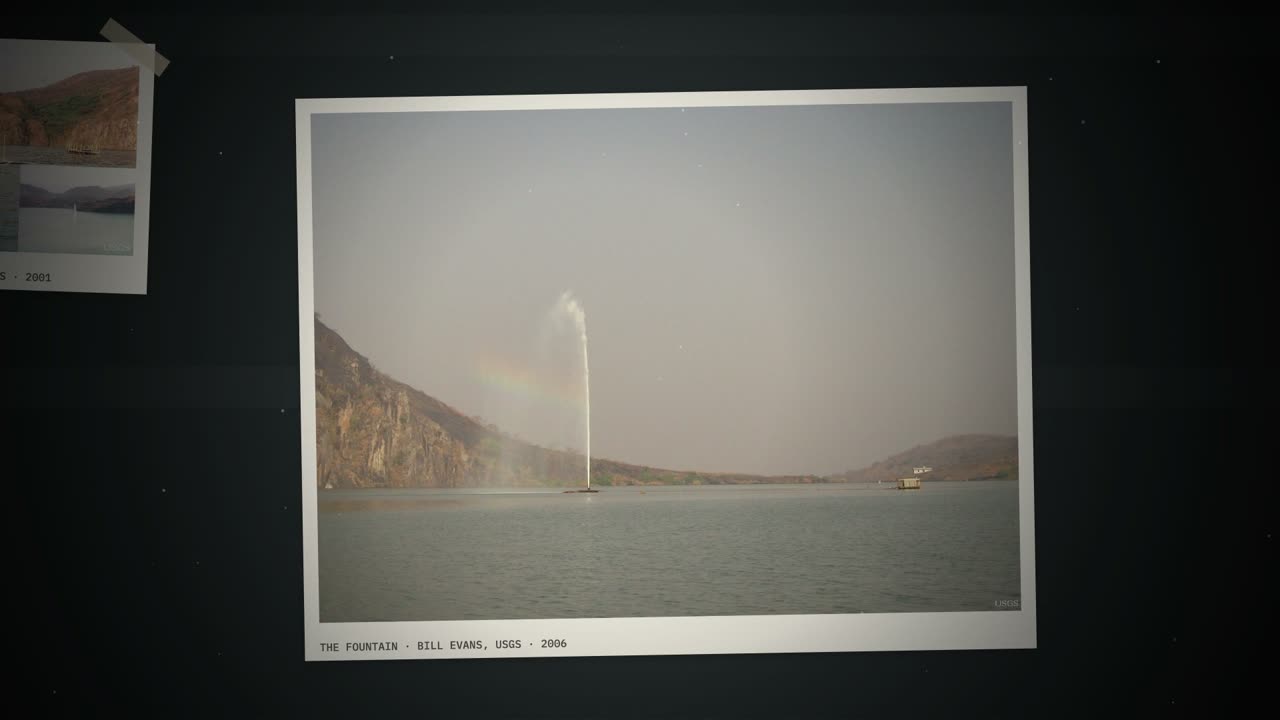
It is still not the gas you are seeing. It is water, thrown up by the gas. But it is a white column over the lake, like the cloud one man saw in 1986, only now it comes out slowly and on purpose. For the first time, the gas is doing something a camera can film. According to one account, when the forced degassing began in 2001, the lake even turned red again. [2]
The natural dam at the lake's north end, called weak in 1987, was reinforced between 2010 and 2016. [1, 2] The lake is under control.
What the pictures really show
No smoke. No fire. No wreckage. That night left nothing for a camera, so every picture of Lake Nyos is a picture of what it did: a lamp with oil still in it, red water, a line down a valley, and a white fountain over a quiet lake.
And behind every one of those pictures are the people of Nyos. As of 2021, according to the geologist who mapped the area, the people evacuated from around the lake had still not formally returned to their villages. [2]
Sources
- G. W. Kling, M. A. Clark, H. R. Compton, J. D. Devine, W. C. Evans, A. M. Humphrey, E. J. Koenigsberg, J. P. Lockwood, M. L. Tuttle, G. N. Wagner, "The 1986 Lake Nyos Gas Disaster in Cameroon, West Africa", Science 236 (10 April 1987), pp. 169-175.
- Flip Kips, "Wat weten we 35 jaar na dato over de oorzaak van de dodelijke gaseruptie van het Nyosmeer (Kameroen)?", Grondboor & Hamer 2-2021, pp. 92-101. natuurtijdschriften.nl
- Jacques Varet, "Haroun Tazieff (1914-1998)", Travaux du COFRHIGÉO, 3e série, t. XXIII, no. 6 (2009), pp. 115-146. annales.org
- Frank Westerman, Stikvallei (De Bezige Bij, 2013); English sample translation "Choke Valley" by Sam Garrett. debezigebij.nl
- Wikimedia Commons, Lake Nyos photos by Jack Lockwood and Bill Evans, U.S. Geological Survey (public domain). commons.wikimedia.org
- Academy of Motion Picture Arts and Sciences, "The 39th Academy Awards", Documentary (Feature) nominees. oscars.org
- NASA Goddard Space Flight Center, Scientific Visualization Studio, "Lake Nyos Zoom-in" (2002), ID 2348. svs.gsfc.nasa.gov
- ACS Reactions / PBS, "The Invisible Tsunami That Killed 1,500 People in One Night" (2020). pbs.org
- Eos, "Cameroon's Lake Nyos Gas Burst: 30 Years Later" (2016). eos.org
- Camer.be (2026), on the 40th anniversary of Nyos. camer.be
- Wikimedia Commons, "Lake Nyos 1986 001" and "Cow killed by Lake Nyos gasses", Jack Lockwood, U.S. Geological Survey (public domain). commons.wikimedia.org
- World Press Photo, 1987 Photo Contest, Eric Bouvet. worldpressphoto.org